Attio vs. Folk: Which CRM works for growing teams?

Lightfield
Quick summary
Attio is a flexible, object-based CRM for technical founders who want full control over their data model. Folk is a lightweight, relationship-first CRM for small teams who want to move fast with minimal setup. Both are well-designed products — but both still depend on your team to do the logging.
Both CRMs solve different problems, but share the same blind spot
Attio and Folk both promise to replace the clunky CRM. But after testing both, we kept running into the same problem: your team still has to do the logging.
Attio gives you a powerful schema to organize data, but someone has to put the data in. Folk makes it fast to capture contacts, but the context behind those contacts — what was said, what was promised, what needs follow-up — still lives in your head or your inbox. Whichever tool you pick, the manual work doesn't go away. It just looks different.
Why listen to us
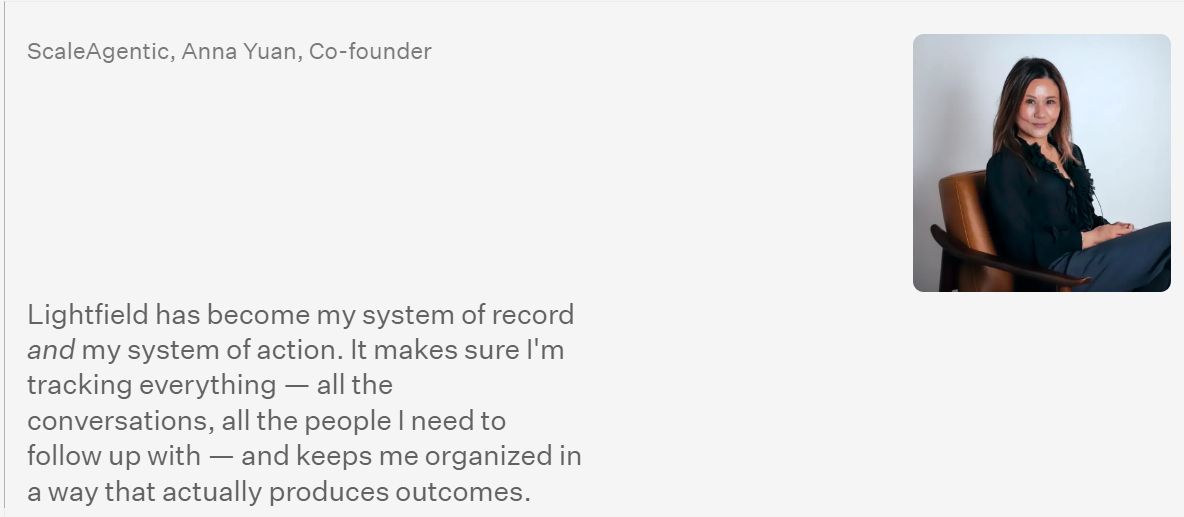
We build Lightfield for teams who are tired of CRM admin getting in the way of actually selling. That puts us in close contact with the limitations of every major platform on the market, including Attio and Folk. We're not neutral, but we are specific — and we've spent a lot of time with both tools.
Attio vs. Folk: Key differences
1. Data model: Flexibility vs. simplicity
Attio gives you a fully configurable object-based data model. You can create custom objects, define bi-directional relationships between records, and model complex workflows — partnerships, investor tracking, multi-stage deal types.
This is genuinely powerful, but it requires meaningful upfront configuration and ongoing maintenance. Custom objects are only available on Pro ($69/user/month annual), so you need to be on the right plan before the flexibility kicks in.
Folk takes the opposite approach: a spreadsheet-style interface with custom fields and pre-built pipeline templates. You're up and running in minutes. The tradeoff is that you can't create custom object types or model relationships between entities the way Attio lets you. What you see is what you get — and for many small teams, that's exactly what they want.
Verdict: Attio if your workflows are complex and you need a flexible schema. Folk if you want speed and simplicity over structural depth.
2. Outreach and sequences: Who does it better?
Folk has a clear edge on outbound. The folkX Chrome extension captures contacts from LinkedIn, X, and websites in a single click — which is genuinely fast for teams that live in those channels.
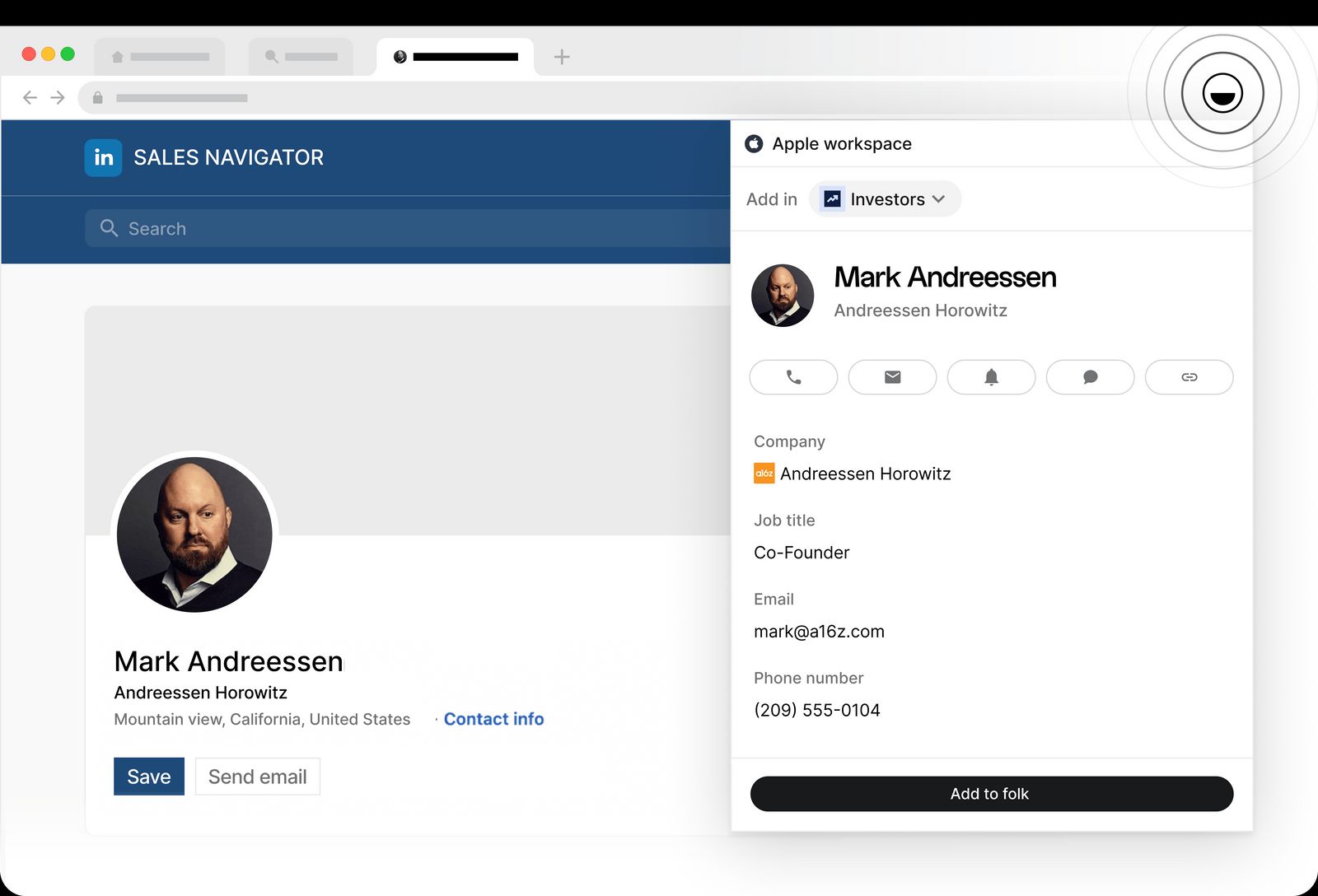
Email campaigns are available on Standard ($24/user/month annual), and AI-powered email sequences with multi-step follow-ups unlock on Premium ($48/user/month annual). Folk also has native WhatsApp integration, which is rare at this price point.
Attio's email capabilities are more limited on lower tiers. Sequences require Pro ($69/user/month annual). The Free plan caps you at 200 sends per month with "Sent with Attio" branding on every email. There's no native LinkedIn capture tool and no WhatsApp integration. Attio's strength is in data modeling and pipeline management — outbound is an afterthought.
Verdict: Folk for teams whose workflow centers on LinkedIn prospecting and email outreach. Attio if outreach is secondary to pipeline management and data modeling.
3. AI and automation: Credits vs. caps
Attio's AI features — Ask Attio, AI attributes, workflow automations — run on a dual-credit system: seat credits for personal use and workspace credits shared across the team. Plus gets 1,500 workspace credits per month; Pro gets 10,000.
When you run out, add-on packs cost $70/month (5,000 credits), $120/month (10,000), or $265/month (25,000). This makes monthly costs genuinely hard to predict for teams running active automations.
Folk's AI features — Magic Fields and AI Assistants — also have caps, but the system is simpler. Standard gets 2,000 Magic Field credits per month (workspace-wide) and 500 enrichment credits per month (workspace-wide). Premium gets 5,000 Magic Fields and 1,000 enrichment credits. No dual-credit complexity, but the workspace-wide limits still hit small outbound teams fast.
Verdict: Neither tool gives you unlimited AI. Both meter usage through credit systems that can constrain what your team actually does day-to-day. Folk's system is simpler to understand; Attio's is more powerful but harder to predict.
What is Attio?
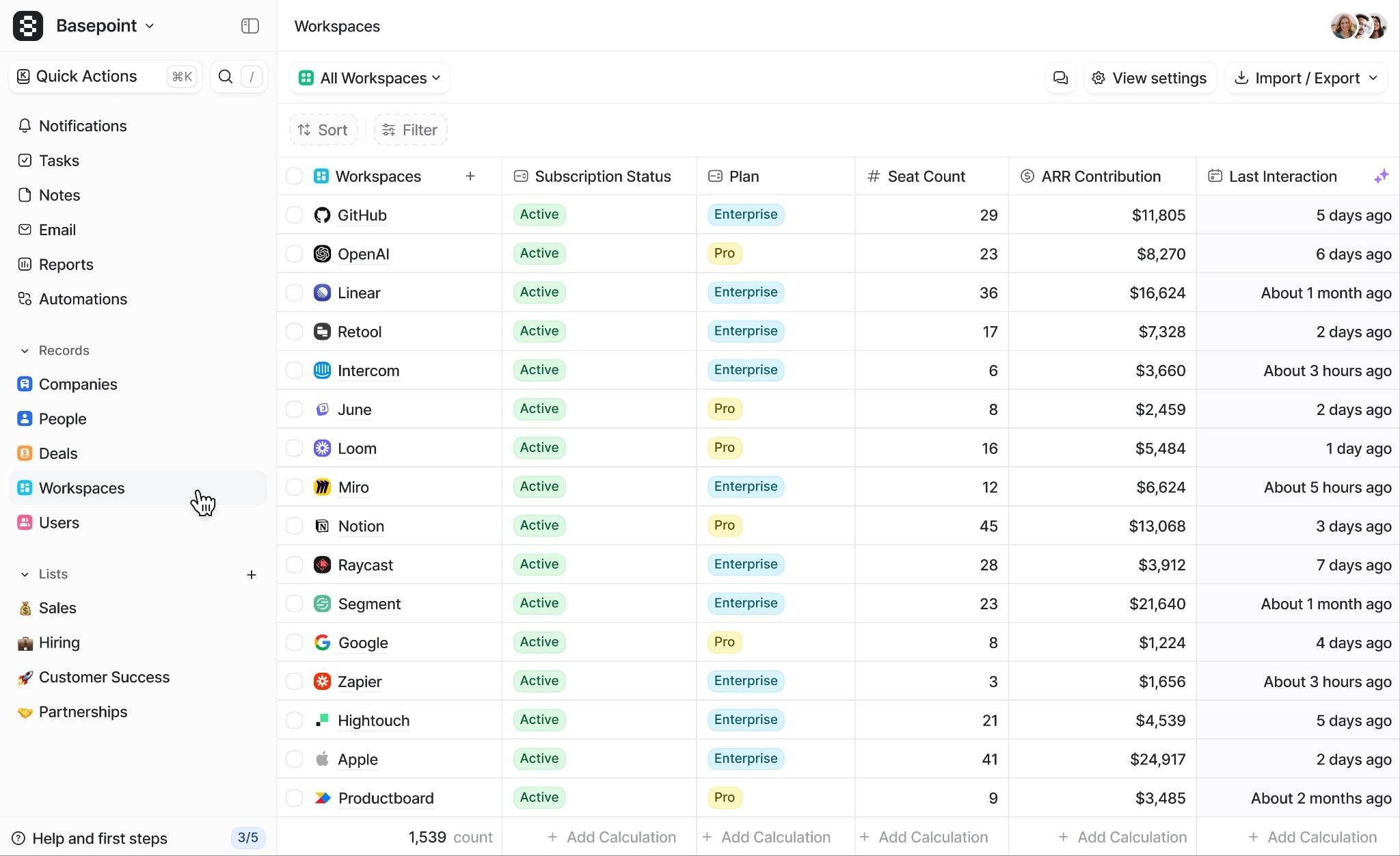
Attio is an AI-native CRM built for GTM teams that refuse to work around pre-baked data structures. The object-based data model is its core differentiator — you define every entity and relationship from scratch, which makes it unusually adaptable to complex sales motions, partnership tracking, or multi-product businesses. The tradeoff is that this flexibility demands setup time. You're building a CRM before you can use one.
Key features
- Object-based data model with custom objects and bi-directional relationships
- Branching workflow automations with AI-powered triggers
- Automatic contact and company enrichment with firmographic data (employee count, ARR, funding)
- Live collaboration with simultaneous editing and shared views
- Native Call Intelligence for meeting recording and transcription (Pro only)
- Real-time email and calendar sync with full interaction history
- Modern API and MCP integration support
Pros
- One-click data enrichment pulls ARR, funding rounds, and firmographic data automatically
- Free plan available for up to 3 users with no credit card required
- Open API and MCP integration let you connect with any tool in your GTM stack
- Filtering and sorting handles large datasets (50,000+ contacts) without slowdown
Cons
- Every object, attribute, and workflow must be configured before the team can use it productively
- Call Intelligence is locked behind Pro ($69/user/month annual)
- The dual-credit system for enrichment and automations makes monthly costs unpredictable
- Building rep-level or multi-variable reports requires significant workarounds
- Most integrations beyond email and calendar depend on Zapier
Attio pricing
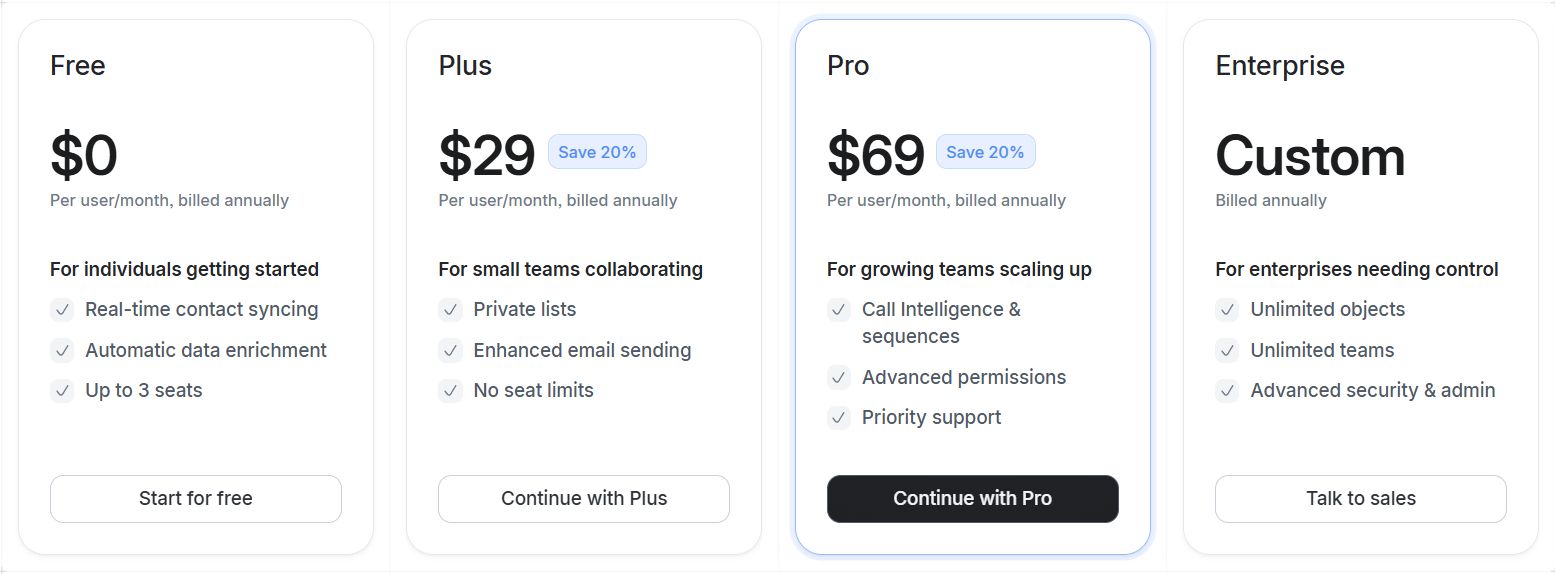
| Plan | Monthly Price | Annual Price | Best For |
|---|---|---|---|
Free | $0 (up to 3 seats) | $0 | Solo founders or very small teams testing the platform |
Plus | $36/user/mo | $29/user/mo | Growing teams needing collaboration, no seat limits, and basic automations |
Pro | $86/user/mo | $69/user/mo | Scaling teams needing Call Intelligence, custom objects, email sequences |
Enterprise | Custom | Custom | Large orgs needing unlimited objects, SAML/SSO, dedicated support |
Key cost detail: Attio's credit system sits on top of the seat price. Workspace credits power workflows and AI features. When they run out, add-on packs cost $70/month (5,000 credits), $120/month (10,000), or $260/month (25,000). This can meaningfully increase total spend for teams running active automations.
What is Folk?
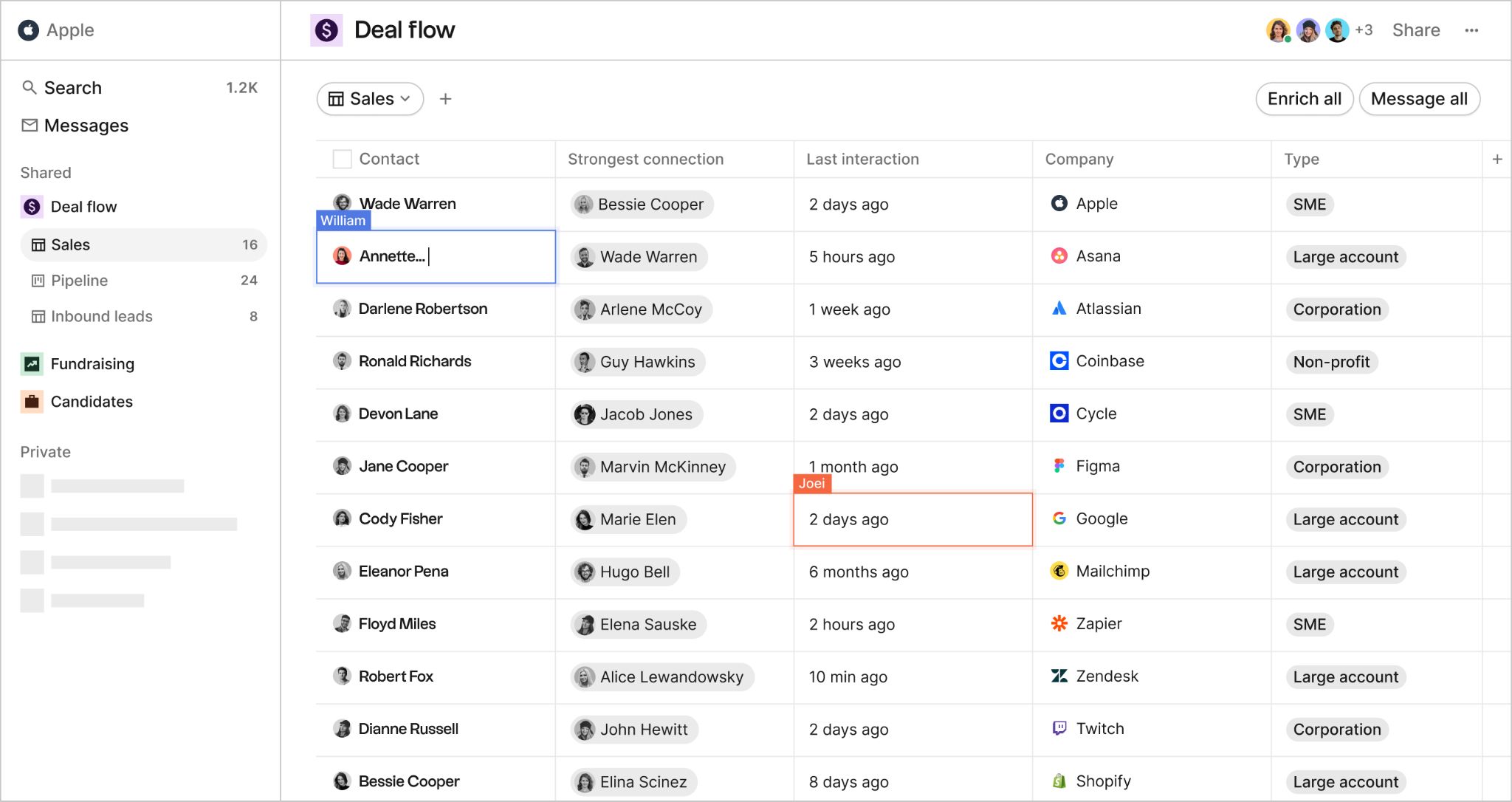
Folk was built to feel as familiar as a spreadsheet and work as well as a CRM. The signature feature is folkX — a Chrome extension that captures contacts from LinkedIn, X, and websites in one click.
Setup is minimal; most teams are productive within an hour of signing up. The feature set is genuinely solid for lightweight relationship management, though the Standard plan's limits mean active sales teams will hit Premium quickly.
Key features
- folkX Chrome extension imports contacts from LinkedIn, X, and websites in a single click
- AI-powered email sequences with persona and goal inputs (Premium only)
- Native WhatsApp integration for syncing conversations
- Magic Fields that use AI to auto-populate custom contact data points
- Pre-built pipeline templates covering sales, recruiting, and partnership workflows
- AI follow-up assistant that scans active pipelines for stalled conversations
- One-click enrichment pulling verified emails, phone numbers, job titles, and company data
Pros
- Minimal onboarding — most teams are productive within an hour
- Clean pipeline interface with flexible custom fields
- Budget-friendly entry point for small teams ($20/user/month annual)
- Automatic deduplication detects and flags duplicate contacts during import
Cons
- No native mobile app on any plan
- Native integrations are narrow (email, calendar, WhatsApp; everything else via Zapier or Make)
- Email sequences and deal management locked behind Premium ($40/user/month annual)
- Dashboards and reporting are still maturing
- Enrichment credits are shared across the whole workspace — not allocated per user — so a three-person team on Standard shares just 500 enrichment credits per month
Folk pricing
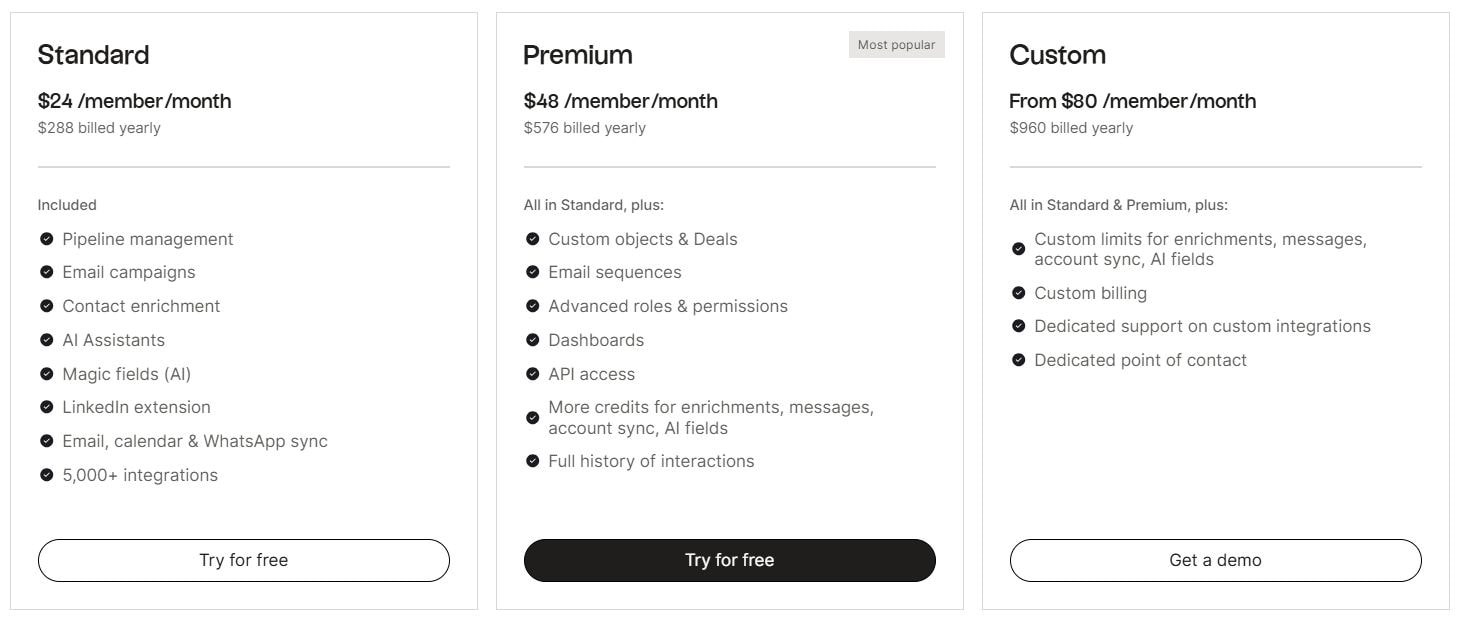
| Plan | Monthly Price | Annual Price | Best For |
|---|---|---|---|
Standard | $30/user/mo | $24/user/mo | Solo users or small teams doing basic contact management and email campaigns |
Premium | $60/user/mo | $48/user/mo | Teams needing deal pipelines, email sequences, dashboards, and API access |
Custom | From $100/user/mo | From $80/user/mo | High-volume teams needing custom credit limits and dedicated support |
Key cost detail: Folk has no free plan. The 14-day trial defaults to Premium features regardless of which plan you select. When the trial ends, your account is blocked until you upgrade. Enrichment credits are workspace-wide — a three-person team on Standard shares just 500 per month.
Lightfield: The CRM that remembers everything for you
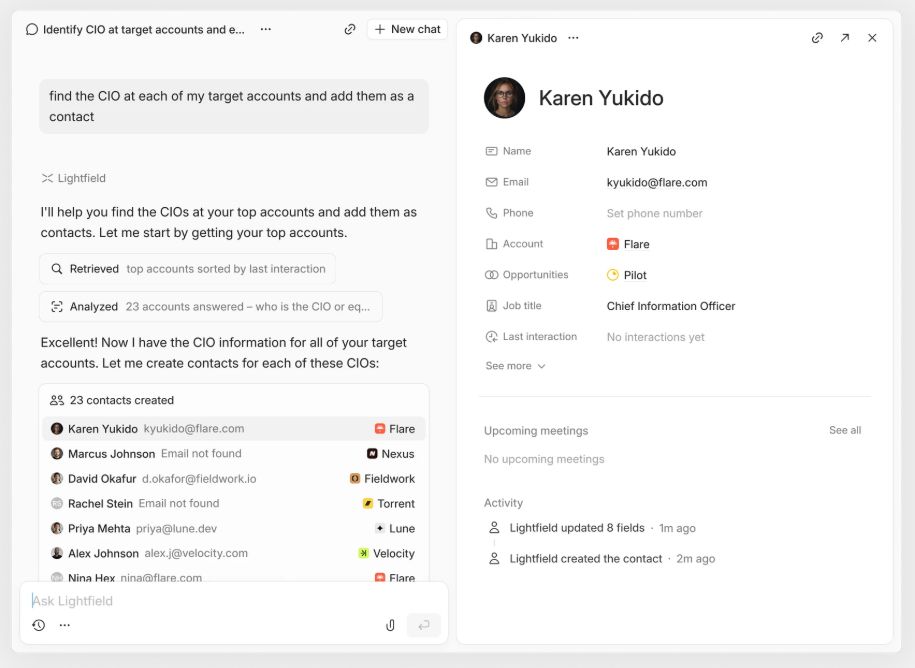
Attio and Folk both solve real problems. Attio gives you an exceptional data model. Folk gives you speed. What neither does is capture what actually happened in your conversations — the detail that makes a CRM useful when you're about to get back on a call or hand off a deal.
Lightfield captures emails, calls, and meetings automatically, matches them to the right contacts and accounts, and turns that into structured CRM records with no manual input. No schema to configure first. No logging to remember. The record exists because the conversation happened — not because someone took five minutes afterward to write it up.
Key features
- Every inbound and outbound email mapped to contacts automatically
- Meeting transcripts tagged to accounts the moment the call ends
- AI surfaces relationship gaps and dormant contacts before they go cold
- Natural language queries across your full conversation history with cited answers
- Retroactive custom fields: add a field today and Lightfield backfills it from months of past conversations
- Up to two years of historical conversation data ingested at signup
Lightfield pricing
Starter
$89/user/month, up to 3 users. 14-day free trial.
Larger teams doing more complex agentic work can move to a team plan with unlimited viewer seats.
Pro
Visit lightfield.app/pricing for details.
Growth
Visit lightfield.app/pricing for details.
Why growing teams prefer Lightfield
1. Conversations become CRM records automatically
Attio gives you a powerful schema but someone has to populate it. Folk captures contacts fast but not what was said on the call.
Lightfield records every email, call, and meeting and turns it into structured data — contacts, accounts, opportunities, follow-up tasks — without anyone touching a form after the conversation ends.
2. No credit system, no tier gates on AI
Both Attio and Folk meter AI usage through credit systems that cap what your team can realistically automate each month.
Lightfield includes unlimited agent queries on every plan — no workspace credit pools to monitor, no add-on packs to buy when automations run hot.
3. Call intelligence without the Pro tax
Attio locks meeting recording and transcription behind Pro at $59/user/month annual. Folk doesn't offer call recording at all.
Lightfield includes call recording, transcription, and AI-generated summaries on the Startup plan — so the feature that captures your most valuable sales context isn't gated behind your most expensive tier.
4. Retroactive custom fields
Neither Attio nor Folk can populate a new field from historical conversation data without manual entry or a purpose-built workflow. Add a field to Lightfield today and it backfills from months of past conversations automatically — so refining your data model as you learn doesn't mean losing the context you've already captured.
5. Built for teams that sell through meetings
If your team runs ten or more calls a week, the most valuable CRM data is what was said on those calls — not what someone logged afterward.
Lightfield is designed around that premise. The product is optimized for conversation-driven sales in a way that contact-focused tools like Folk and schema-focused tools like Attio aren't.
Get the power and simplicity without the manual work
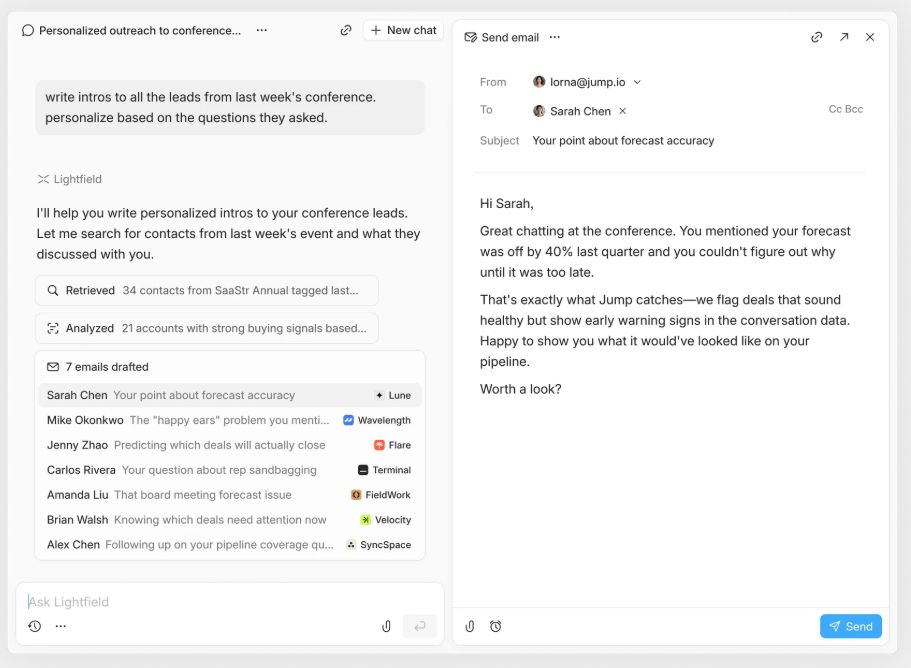
Attio is the right CRM if you want full control over your data model and have the time to build and maintain it. Folk is the right CRM if you want a fast, lightweight tool for LinkedIn-based outreach and contact management.
But both tools share the same gap: they depend on your team to log what happens in conversations. Context gets lost, follow-ups get missed, and the CRM slowly drifts from reality. The more meetings your team runs, the faster that drift compounds.
Lightfield closes that gap. Every conversation is captured, structured, and searchable from day one — with no configuration overhead and no credit limits.
CTA: Try Lightfield free | Request demo