Pipedrive vs. HubSpot: The honest take for early-stage teams

Lightfield
Quick Summary
Pipedrive; Deal-focused CRM built by salespeople, with visual pipelines and activity-based selling that gets reps productive on day one. HubSpot; CRM inside a broader marketing, sales, and service platform that scales from free to enterprise but gets expensive fast.
Choosing Between HubSpot CRM and Pipedrive?
Pipedrive and HubSpot represent two different bets: Pipedrive bets on deal velocity, HubSpot bets on full-funnel orchestration. After testing both, the same gap appears: both tools still depend on reps logging the substance of their interactions manually.
Pipedrive tracks that an activity happened, but not what was said. HubSpot logs emails and calendar events automatically, but call notes, meeting context, and verbal commitments still have to be typed in by a rep who's already moved on to the next deal.
Why Listen to Us?

We build Lightfield at the intersection of CRM and AI. That means we spend our days studying where even well-resourced platforms consistently fall short in daily use — including Pipedrive and HubSpot. We work directly with teams migrating from both, which gives us first-hand visibility into the gaps.
Pipedrive vs HubSpot: Key Differences
Comparison summary table:
| # | Feature/Area | Pipedrive | HubSpot |
|---|---|---|---|
1 | Scope | For teams only needing a dedicated sales pipeline | For teams needing marketing, sales, and service to share a single customer record |
2 | AI and Automation | Simpler AI capability, credit-based billing on top of your subscription is not added | Broader AI vision with autonomous agents and cross-hub intelligence |
3 | Pricing and Total Cost | Predictable pricing for pure sales teams, though add-ons inflate the bill | Free tier available, but pricing gap between Starter and Professional is steep |
Scope: Sales Tool vs Full Platform
Pipedrive
Pipedrive is a sales CRM, full stop. Visual Kanban pipelines, activity tracking, deal rotting alerts, sequences, and a meeting scheduler. It does one thing well and doesn't pretend to be a marketing or service platform. You'll need external tools for email marketing, content, and support, but the core selling experience is clean and focused.
HubSpot
HubSpot is five hubs in one: Marketing, Sales, Service, Content, and Commerce. The strength is a shared customer record across every team. The weakness is complexity. HubSpot's Sales Hub alone competes with Pipedrive, but the platform's real value only shows up when you're running multiple hubs together — and that's where cost compounds.
Verdict: Pipedrive if your team only needs a dedicated sales pipeline. HubSpot if you need marketing, sales, and service sharing a single customer record.
AI and Automation: Assistants vs Agents
Pipedrive
Pipedrive's AI Sales Assistant analyses your pipeline to predict deal win probability and recommend next actions. AI email writing and thread summarisation (powered by OpenAI) are available on Premium and above. Workflow automations cap at 50 on Growth, 150 on Premium, 250 on Ultimate. There's no natural language CRM querying or autonomous agent capabilities.
HubSpot
HubSpot's Breeze AI suite is more expansive: Breeze Assistant (task and content support), Breeze Agents (Customer Agent, Prospecting Agent, Data Agent), and Breeze Intelligence (data enrichment, buyer intent). But Breeze features run on HubSpot Credits — a usage-based currency on top of your subscription. Pro plans include a baseline allowance; additional credits cost $10/1,000.
Verdict: HubSpot has the broader AI vision with autonomous agents and cross-hub intelligence. Pipedrive's AI is simpler but doesn't add credit-based billing on top of your subscription. Neither tool automatically captures conversation content.
Pricing and Total Cost: Per-Seat vs Per-Everything
Pipedrive
Pipedrive charges per seat with no free plan. Lite starts at $14/user/month (annual), Growth at $39, Premium at $49, Ultimate at $79. Add-ons are billed per company: LeadBooster ($32.50/month), Campaigns ($13.33/month), Web Visitors ($41/month), Smart Docs ($32.50/month). A 5-person team on Growth with LeadBooster and Campaigns hits $240+/month.
HubSpot
HubSpot has a free CRM (2 users, 1M contacts, HubSpot branding). Sales Hub Starter costs $20/seat/month. But the Starter-to-Professional jump is massive: Sales Hub Pro starts at $100/seat/month with a $1,500 one-time onboarding fee. Marketing Hub Pro is $890/month with a $3,000 onboarding fee. Breeze AI credits make costs harder to forecast.
Verdict: Pipedrive is more predictable for pure sales teams, though add-ons inflate the bill. HubSpot's free tier is a strong entry point, but scaling past Starter into Professional creates sticker shock that catches most teams off guard.
What Is Pipedrive?
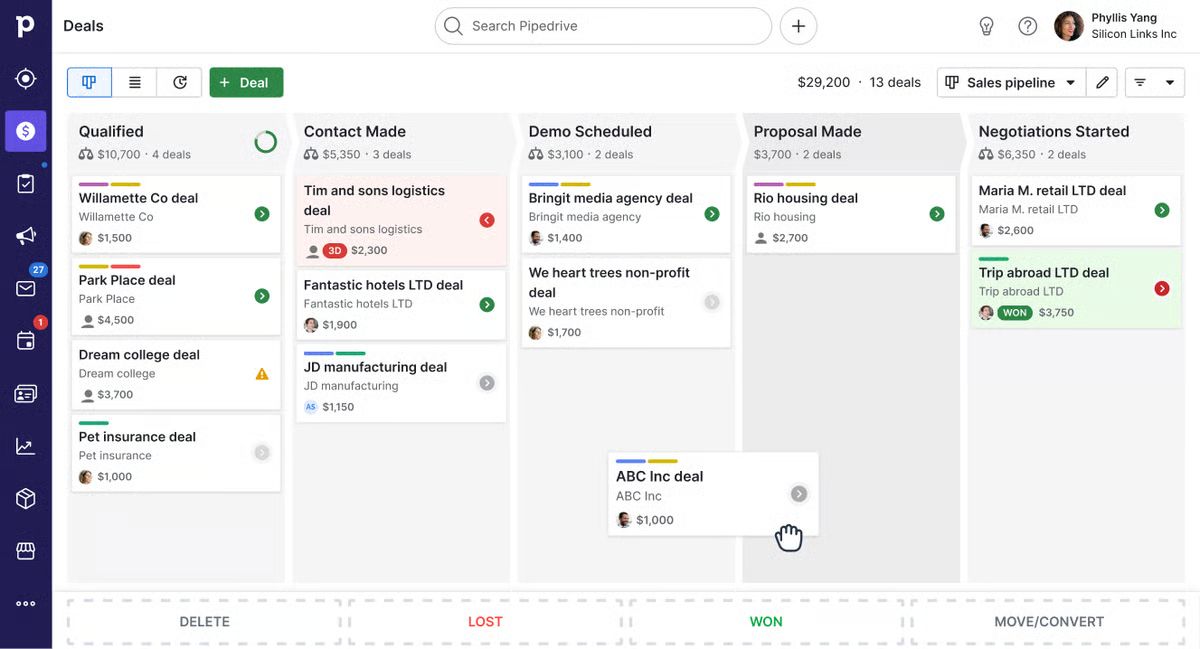
Pipedrive is a pipeline-centric sales CRM built by salespeople for salespeople. Visual Kanban deal tracking, activity-based selling methodology, and a clean UI that gets teams productive fast. Strong mobile apps and 500+ integrations round out the offering — but costs add up with add-ons and feature gating across plan tiers. Plans were rebranded in late 2025 to Lite, Growth, Premium, and Ultimate.
Key Features
- Visual sales pipeline: Visual Kanban pipeline with drag-and-drop deal cards and deal rotting alerts.
- AI sales assistant: Flags neglected deals, predicts win probability, and recommends next actions (Premium+).
- OpenAI email assistant: AI email writer and email thread summarisation powered by OpenAI.
- LeadBooster add-on: chatbot, live chat, web forms, Cognism-powered prospector.
- Email and communication tools: Two-way email sync with open/click tracking (Growth+).
- Meeting scheduler: With Google Meet, Zoom, and Teams links.
- Campaigns add-on: Email marketing with segmentation and automations.
- Smart Docs: Trackable quotes, proposals, and e-signatures (Premium+ or add-on).
- Integrations: 500+ app integrations via native marketplace.
Pros
- Strong iOS and Android apps for pipeline updates on the go
- Activity-based methodology keeps reps focused on actions, not data entry
- Customisable revenue forecasting and deal velocity reporting (Premium+)
- Clean UI with fast onboarding; most teams productive within hours
- No credit system; feature access is plan-based, not usage-metered
Cons
- No free plan on any tier; 14-day trial only
- Add-on pricing stacks fast: LeadBooster ($32.50/mo), Campaigns ($13.33/mo), Web Visitors ($41/mo), Smart Docs ($32.50/mo)
- Two-way email sync not available on Lite
- AI features (win probability, email writer, Sales Assistant) gated behind Premium ($49/user/month annual)
- Sales-only by design; limited marketing, service, or post-sale functionality
- Automation caps are rigid: 50 on Growth, 150 on Premium, 250 on Ultimate
Pipedrive Pricing
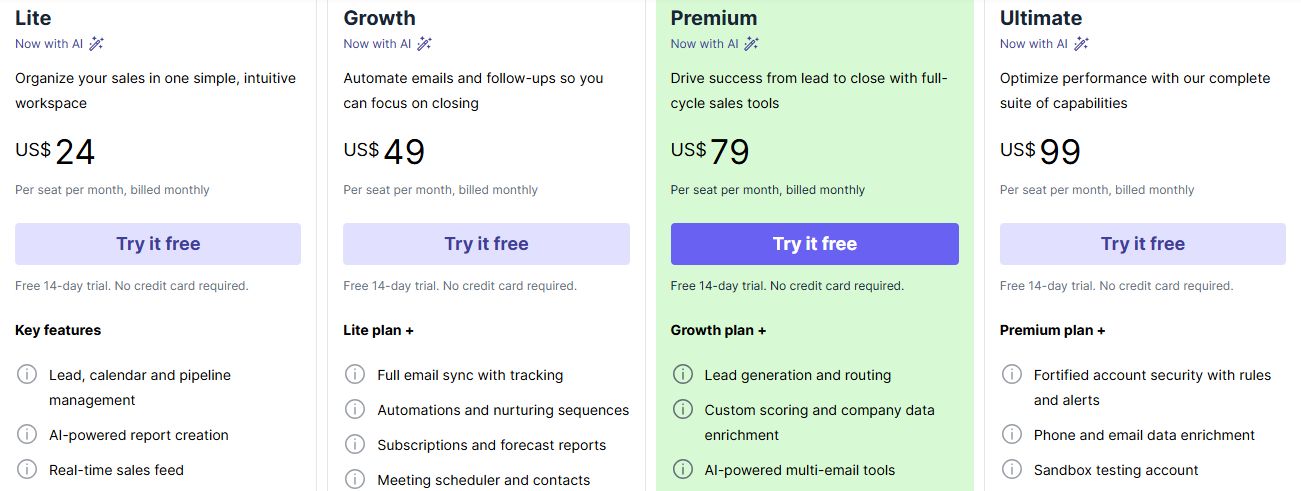
| Plan | Annual price | Monthly price | Best For |
|---|---|---|---|
Lite | $14/seat/month | $24/seat/month | Solo users or small teams doing basic pipeline management |
Growth | $39/seat/month | $49/seat/month | Small teams needing email sync, automations, and sequences |
Premium | $59/seat/month | $79/seat/month | Scaling teams needing AI features, LeadBooster, forecasting, phone support |
Ultimate | $79/seat/month | $99/seat/month | Large orgs needing sandbox, extended support, max automation limits |
No free plan. 14-day trial defaults to Premium features. Essential add-ons are billed per company (not per user): LeadBooster from $32.50/month, Campaigns from $13.33/month, Web Visitors from $41/month, Smart Docs from $32.50/month.
LeadBooster and Projects are included on Premium and above. A 5-person team on Growth with LeadBooster and Campaigns can easily exceed $240/month before any upgrades.
What Is HubSpot?
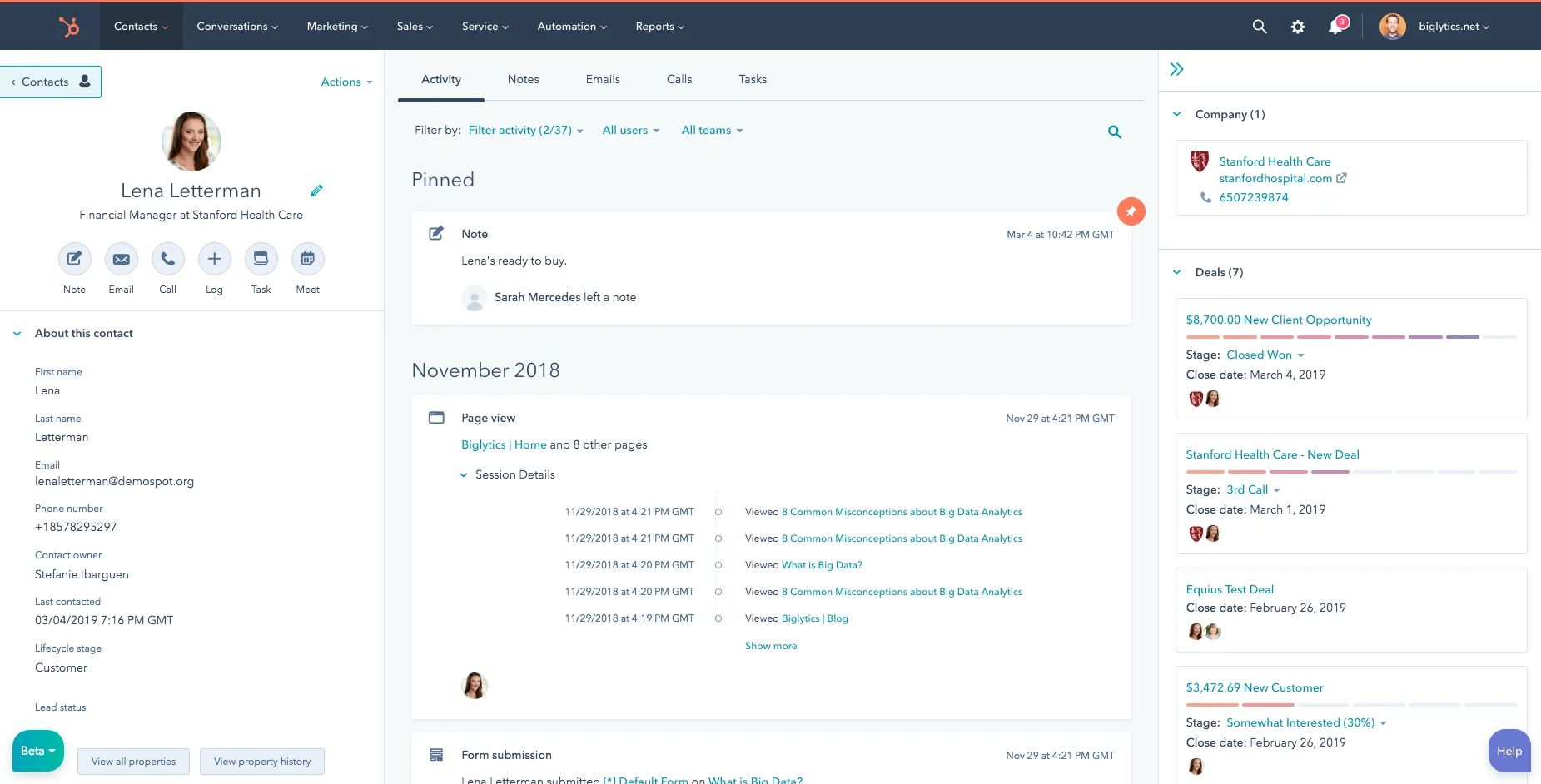
HubSpot is a full-platform CRM: marketing, sales, service, content, and commerce in one system. The Sales Hub competes directly with Pipedrive, but HubSpot's real pitch is a unified customer record shared across every team. The free CRM is generous for testing but limited for real use. Professional plans are powerful, but the Starter-to-Pro jump is the steepest in CRM. Breeze AI features are expanding fast but run on a credit system that adds cost unpredictability.
Key Features
- Five hubs: Marketing, Sales, Service, Content, Commerce — all sharing one customer record.
- Breeze AI suite: Assistant (task and content), Agents (Customer, Prospecting, Data), Intelligence (enrichment, buyer intent).
- Visual deal pipelines: Drag-and-drop boards with auto-logged email and calendar activity.
- Marketing automation: Lead scoring, journey builder, A/B testing, multi-channel workflows.
- Attribution reporting: Connect ad spend to closed revenue.
- Content hub: Landing pages, blog, SEO optimisation.
- Integrations: 1,800+ app integrations via marketplace.
Pros
- Free tier includes CRM, email marketing, live chat, and forms (up to 2 users)
- Unified customer record across marketing, sales, and service reduces data silos
- HubSpot Academy reduces onboarding time with free certification courses
- Massive integration marketplace (1,800+ apps)
- Standard data enrichment included free with every Core Seat (as of late 2025)
Cons
- Free plan limited to 2 seats with HubSpot branding on all outbound communications
- Starter-to-Professional jump is steep: Sales Hub goes from $20/seat to $100/seat with a $1,500 onboarding fee
- Marketing Hub pricing scales by both seats and marketing contacts, making costs compound fast
- Breeze AI features run on HubSpot Credits ($10/1,000 credits); usage-based billing on top of your subscription
- Custom objects only available on Enterprise tiers
- Often requires a dedicated admin or agency partner to manage effectively at scale
HubSpot Pricing (Sales Hub)
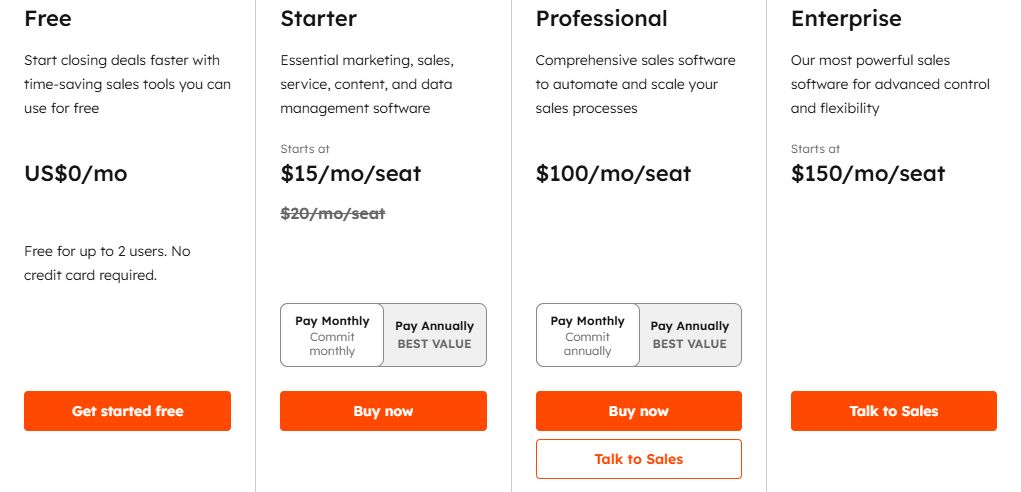
| Plan | Annual Price | Monthly Price | Best For |
|---|---|---|---|
Free CRM | $0 forever | $0 forever | Testing the platform; basic contact management with HubSpot branding |
Starter | $15/seat/month | $20/seat/month | Small teams needing branding removal, 2 pipelines, basic email tools |
Professional | $90/seat/month | $100/seat/month | Scaling teams needing sequences, forecasting, custom reporting, phone support |
Enterprise | $150/seat/month | $150/seat/month | Large orgs needing custom objects, predictive lead scoring, advanced permissions |
Sales Hub pricing is per seat, but HubSpot's real cost is the full platform. Adding Marketing Hub Professional ($890/month base + $3,000 onboarding) or Service Hub Professional ($100/seat/month + $1,500 onboarding) inflates the bill fast.
Breeze AI credits sit on top: Pro plans include a baseline allowance, but additional credits cost $10/1,000. A 5-person team on Sales Hub Professional alone pays $500/month in seats before any add-ons, credits, or marketing costs.
Lightfield: The CRM That Captures the Conversation
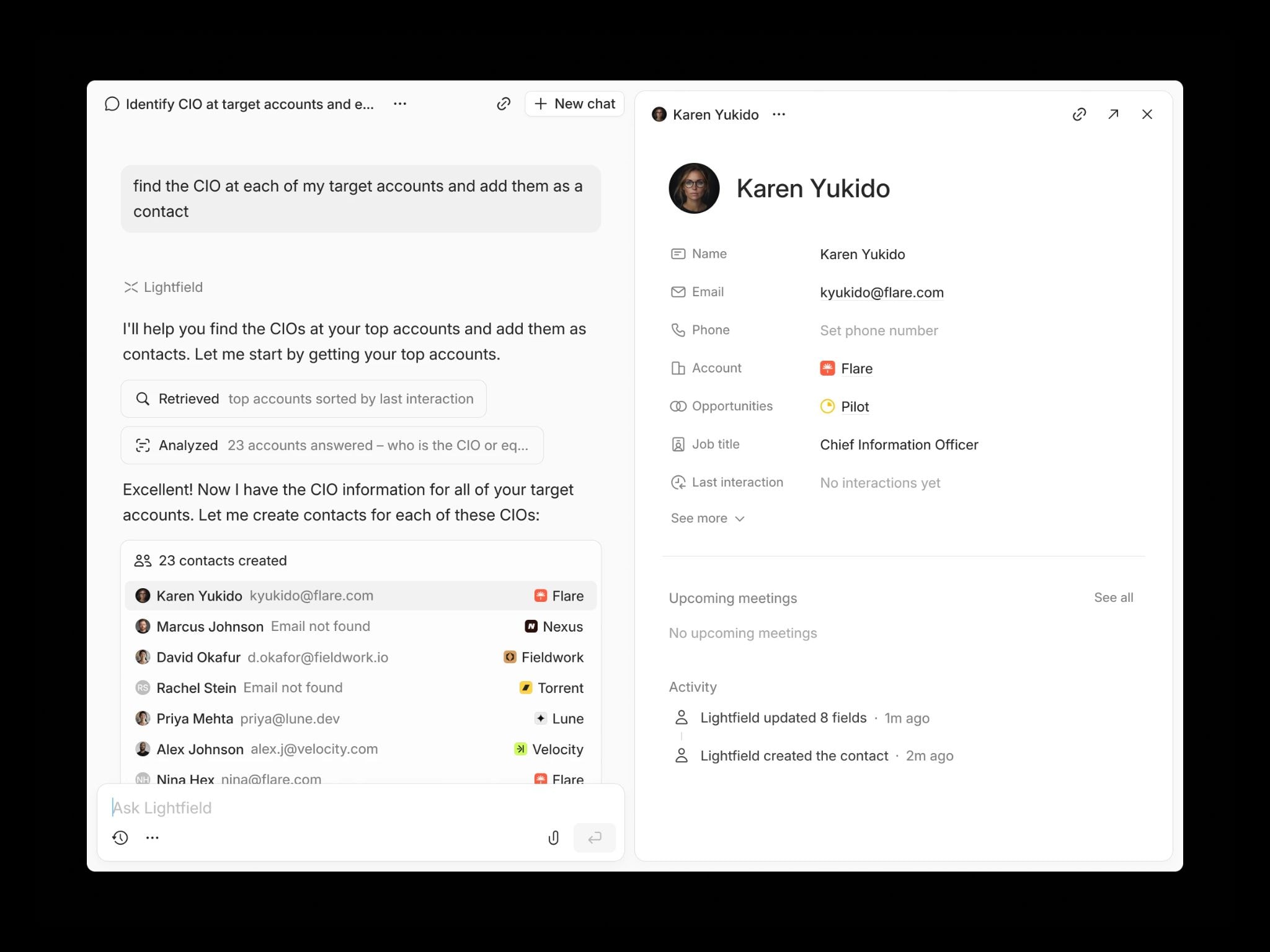
Pipedrive tracks that an activity happened. HubSpot logs the email and the calendar invite. But neither tool captures what was actually said on a call, what was promised in a meeting, or what context a rep needs before their next touchpoint. Lightfield starts where those platforms stop: automatic conversation capture across email, calls, and meetings, matched to the right contacts and turned into queryable CRM records without anyone typing a note.
Key Features
- Auto-capture CRM: emails, calendar events, and meetings flow into contacts, accounts, and opportunities without manual input.
- Integrated call intelligence: Built-in call recording with searchable transcripts and AI-generated summaries, and phone call capture and transcription alongside video meetings.
- Agentic chat over customer data: Natural language queries with cited answers across your full conversation history.
- Retroactive custom fields: Add a field today, Lightfield backfills it from months of past data.
- Multi-account email drafting: Draft emails using prospects' own language and context.
- Auto task generation: Generate tasks directly from meeting transcripts.
Conversation history: Up to two years of historical conversation data ingested at signup.
Lightfield Pricing
Starter
$89/user/month, up to 3 users. 14-day free trial.
Larger teams doing more complex agentic work can move to a team plan with unlimited viewer seats.
Pro
Visit lightfield.app/pricing for details.
Growth
Visit lightfield.app/pricing for details.
Why Growing Teams Prefer Lightfield
1. Your CRM captures the full conversation, not just the calendar event
HubSpot auto-logs emails and meetings to the timeline, but what was said on that call still depends on a rep's memory. Pipedrive doesn't even auto-log emails on its base plan. Lightfield records every email, call, and meeting and turns that context into structured CRM data without anyone typing a note.
2. No credits, no add-ons, no onboarding fees.
HubSpot layers credit-based AI billing on top of seat pricing and charges $1,500–$3,500 in mandatory onboarding fees on Professional plans. Pipedrive stacks per-company add-ons that double the base price. Lightfield includes unlimited agent queries and call intelligence on every plan with no hidden line items.
3. Replaces your Pipedrive + Fathom + spreadsheets stack.
Many teams running Pipedrive bolt on a call recorder, a note-taking tool, and a spreadsheet to track what was actually said. Lightfield handles recording, transcription, CRM updates, and follow-up generation in one tool.
4. Retroactive custom fields.
Add a new field to Pipedrive or HubSpot and it's empty until someone fills it in or you build a workflow. Add a field to Lightfield and it backfills from months of past conversations automatically.
5. Built for founder-led teams doing 10+ meetings a week.
If your team sells through conversations, the most valuable CRM data is what was said in those conversations. Lightfield is built around that reality. Pipedrive and HubSpot are built around pipeline stages and marketing funnels.
The Pipeline Tool You Actually Wanted
Pipedrive is the right CRM if your team needs a clean, focused sales pipeline with strong mobile apps and wants to be selling by end of day. HubSpot is the right CRM if you need marketing, sales, and service teams working from a shared customer record and you're ready to invest in the platform long-term.
But both tools leave the most valuable data on the table: what was actually said in your conversations. Reps still have to log notes, update fields, and remember what they promised. The pipeline drifts from reality.
Lightfield captures every conversation so your CRM reflects what actually happened — not what reps had time to log.