Folk vs HubSpot: Which CRM should you choose in 2026?

Lightfield
Quick summary
Folk = Fast-setup, relationship-first CRM for small teams doing LinkedIn-based outreach and contact management. HubSpot = Full-platform CRM for scaling GTM with marketing, sales, and service under one roof.
Choosing your next CRM?
Folk optimizes for speed and simplicity. HubSpot optimizes for scale and full-funnel visibility.
But both share the same frustration: the CRM only reflects what someone chose to log, not what actually happened. Call context, verbal commitments, and follow-up details still live in your inbox or your head.
The question isn't which tool has better features. It's whether either tool gives you a complete picture without manual work.
Why listen to us?
Lightfield sits at the intersection of CRM and AI. We work with teams migrating from both Folk and HubSpot, which gives us direct visibility into where these platforms are advancing and where they still create manual work.
Folk vs HubSpot: Key differences
1. Setup and time to value
Folk is genuinely fast. Most teams are productive within an hour. The folkX Chrome extension, pre-built pipeline templates, and spreadsheet-style interface mean minimal onboarding. But you hit limits quickly: deal management, sequences, and dashboards all require Premium ($48/user/month annual).
HubSpot's free tier is functional for basic CRM, but getting real value (automation, sequences, custom reporting) requires Professional, which starts at $90/seat/month (billed annually; $100 monthly) for Sales Hub plus a $1,500 mandatory onboarding fee. Setup at that tier often requires a dedicated admin or agency.
Verdict: Folk for teams that need to be productive this week. HubSpot if you're building for scale and can invest the setup time and budget.
2. Outreach and marketing
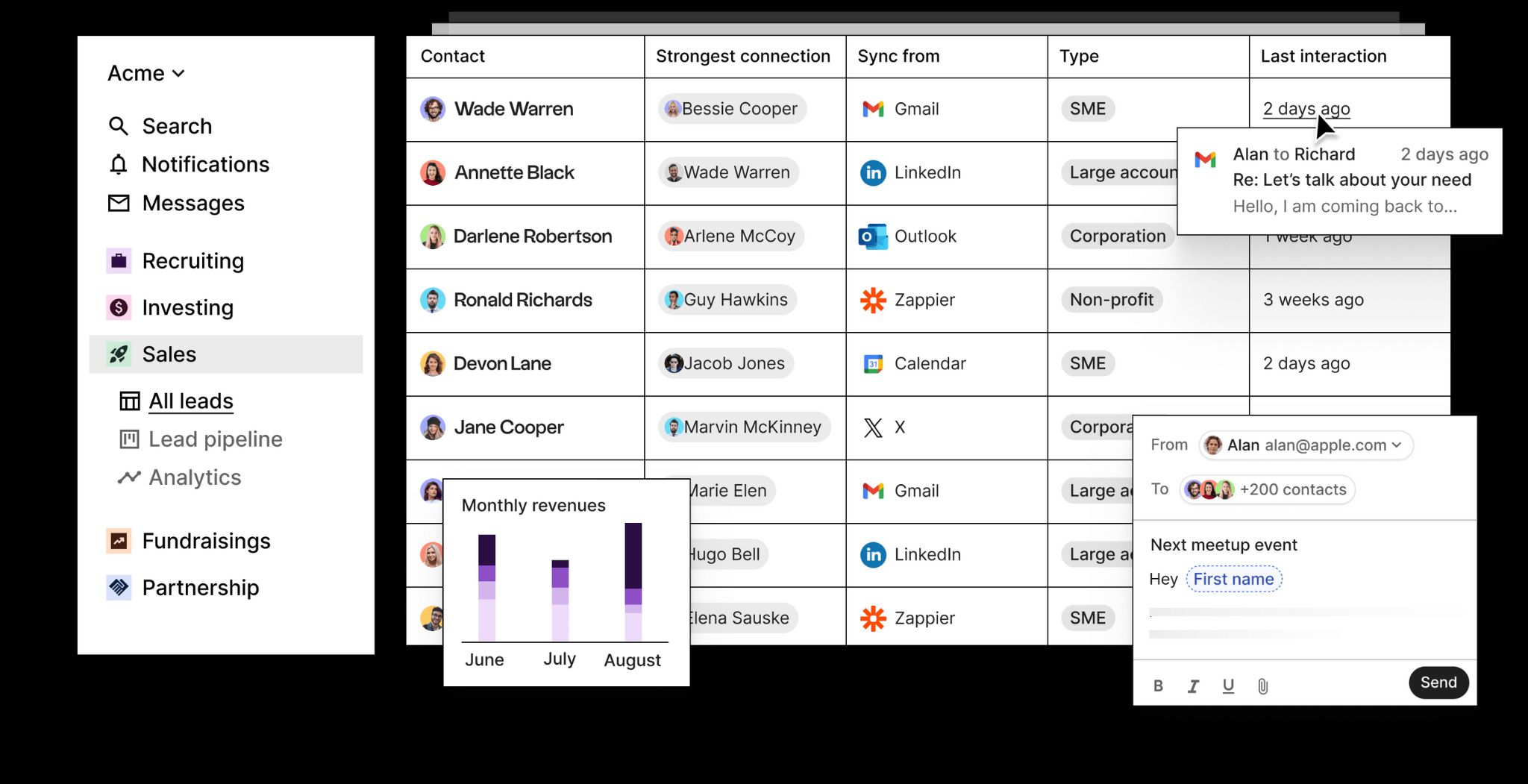
Folk is purpose-built for outbound. folkX captures contacts from LinkedIn and websites in one click. Email campaigns are available on Standard ($24/user/month), and AI-powered sequences are on Premium ($48/user/month). Native WhatsApp integration rounds out the channel mix. But there's no marketing automation, no landing pages, no attribution reporting.
HubSpot is unmatched on marketing. Lead scoring, journey builder, A/B testing, attribution reporting, and a full content hub. But Marketing Hub Professional starts at $890/month (2,000 contacts), and marketing contact pricing scales with your database, not just your team.
Verdict: Folk for teams whose primary motion is LinkedIn prospecting and email outreach. HubSpot if you need full-funnel marketing automation and are prepared for the cost.
3. Pricing and cost trajectory
Folk's entry price is low at $24/user/month annual on Standard. But feature gaps push most sales teams to Premium ($48/user/month) within weeks. A 5-person team on Premium pays just over $200/month. Enrichment credits are workspace-wide — 500 on Standard, 1,000 on Premium — limiting outbound volume.
HubSpot's free CRM is generous (up to 1,000,000 contacts), but the Starter-to-Professional jump is one of the steepest in SaaS. Sales Hub goes from $20/seat to $90/seat (billed annually). Marketing Hub goes from $20/month to $890/month. Add mandatory onboarding fees ($1,500 for Professional, $3,500 for Enterprise) and metered HubSpot Credits for Breeze AI, and real costs climb fast.
Verdict: Folk is cheaper at every team size for basic CRM. HubSpot's total cost of ownership is significantly higher, but you get marketing automation, service tools, and a unified platform that Folk can't match.
What is Folk?
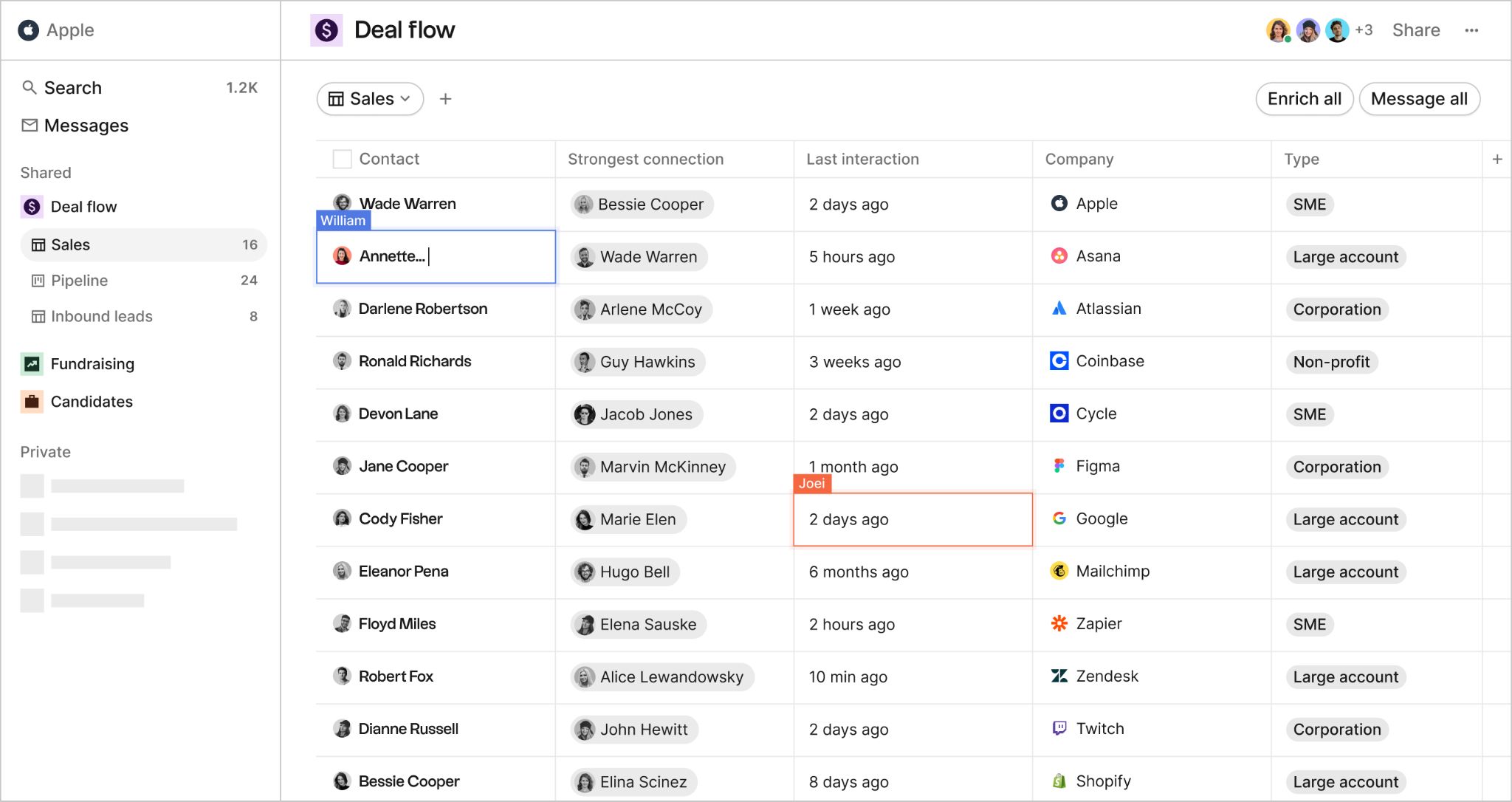
Folk is a lightweight, relationship-first CRM for individuals and small teams. Its spreadsheet-like simplicity, folkX one-click capture from LinkedIn and the web, and AI assistants for follow-ups and sequences make it a natural upgrade from spreadsheets, Notion, or Airtable. It prioritizes getting you set up and outreaching in minutes, not weeks.
Key features
- folkX Chrome extension: one-click capture from LinkedIn, Sales Nav, any website
- AI email sequences from persona/goal inputs (Premium only)
- AI follow-up assistant that detects stalled conversations and suggests re-engagement
- Native WhatsApp integration
- Auto deduplication + enrichment (Clearbit, Apollo, People Data Labs)
- Shared views and collaborative pipelines
- Magic Fields (AI auto-populate) + Smart Fields (real-time updates)
Pros
- Near-zero learning curve, ~20 min setup
- Notion-like customization without technical config
- folkX works across LinkedIn, Sales Nav, and general web
- Follow-up assistant flags stalled deals proactively
Cons
- No mobile app on any plan
- Deal management and pipelines locked behind Premium ($48/user/month annual)
- Limited workflow automation compared to HubSpot or Attio
- Capture strongest on LinkedIn; other channels need manual logging
- Enrichment credits shared workspace-wide (500/month Standard, 1,000/month Premium)
Folk pricing
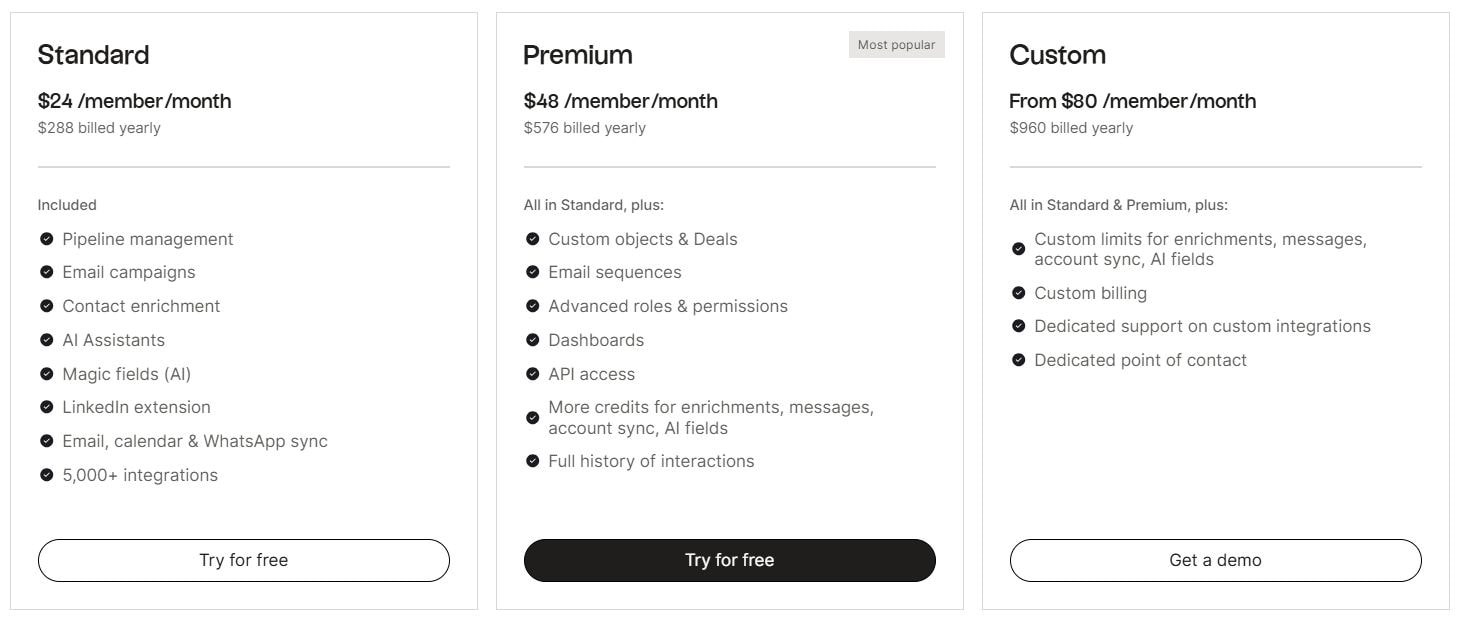
| Plan | Monthly Price | Annual Price | Best For |
|---|---|---|---|
Standard | $30/user/mo | $24/user/mo | Solo users or small teams doing basic contact management and email campaigns |
Premium | $60/user/mo | $48/user/mo | Teams needing deal pipelines, email sequences, dashboards, and API access |
Custom | From $100/user/mo | From $80/user/mo | High-volume teams needing custom credit limits, dedicated support |
No free plan. Two-week trial defaults to Premium features. After trial, the account is blocked until you upgrade. Enrichment credits are workspace-wide — a 3-person team on Standard shares 500 credits/month.
What is HubSpot?
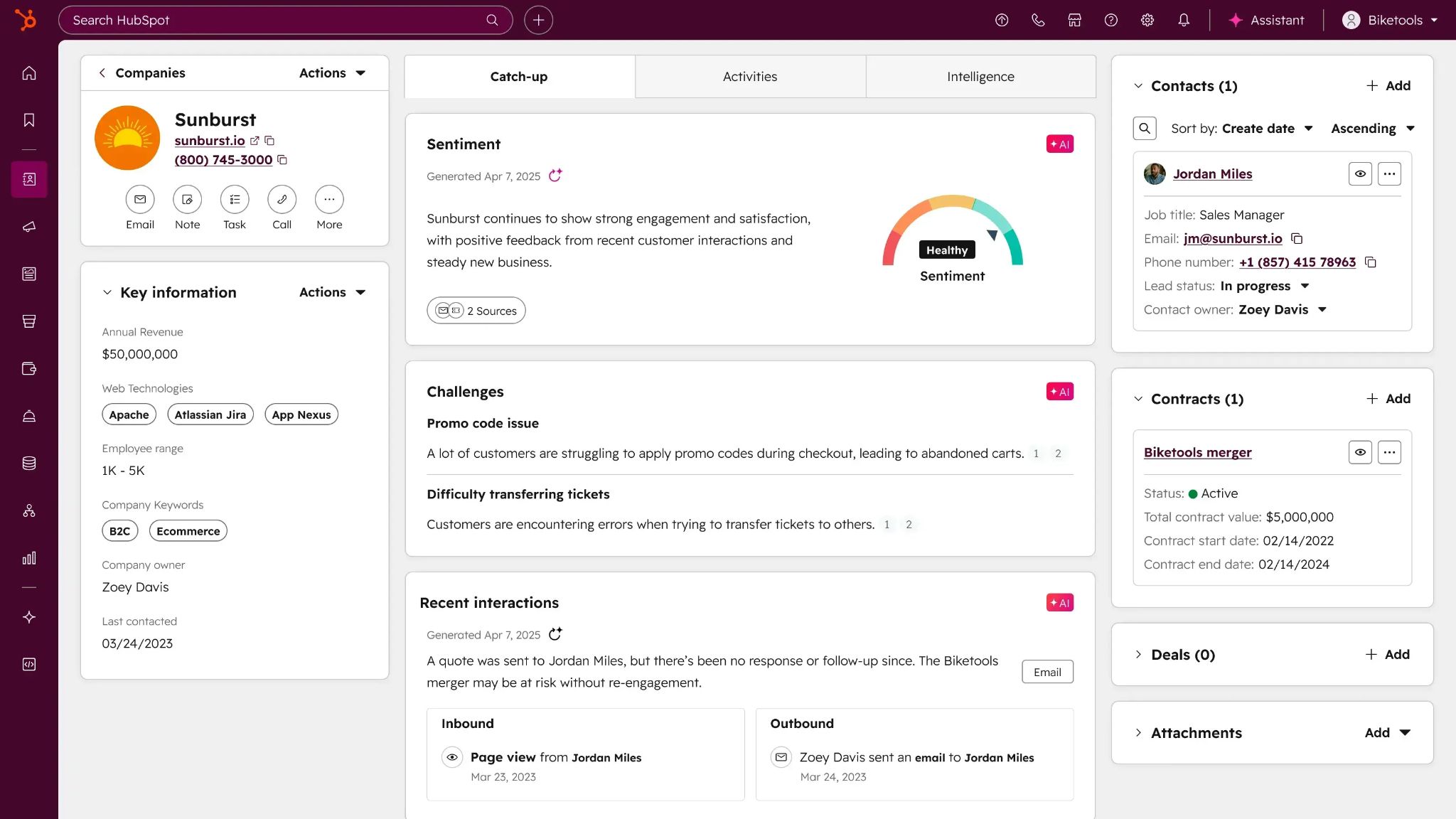
HubSpot is a full-platform CRM covering marketing, sales, service, content, and commerce. A unified customer record, deep automation, rich reporting, and an expanding Breeze AI layer make it the default choice for scaling GTM teams. It scales from free to enterprise, but cost and complexity grow fast alongside feature access.
Key features
- Five hubs: Marketing, Sales, Service, Content, Commerce
- Breeze AI: Copilot (task assist), Agents (workflow automation), Intelligence (data enrichment)
- Visual deal pipeline with auto activity logging from email and calendar
- Marketing automation: lead scoring, journey builder, A/B testing
- Attribution reporting connecting ad spend to closed revenue
- Content hub: landing pages, blog, SEO optimization
- Customer Agent: 24/7 AI-powered ticket resolution
- 1,600+ app integrations
Pros
- Free tier includes CRM, email marketing, live chat, and up to 1,000,000 contacts
- All-in-one: marketing, sales, and service share one customer record
- HubSpot Academy reduces onboarding time significantly
- Massive integration marketplace with 1,600+ apps
Cons
- Pricing by contacts AND seats AND hubs. The Starter-to-Pro jump can go from ~$20/month to $500-$890/month for a single hub
- Professional and Enterprise require mandatory onboarding fees ($1,500 and $3,500 one-time)
- Often needs a dedicated admin or agency to manage properly
- Breeze AI runs on a credits-based model (metered HubSpot Credits, free enrichment removed March 2025)
- Still relies on reps to log non-email, non-calendar activity manually
HubSpot pricing (Sales Hub)
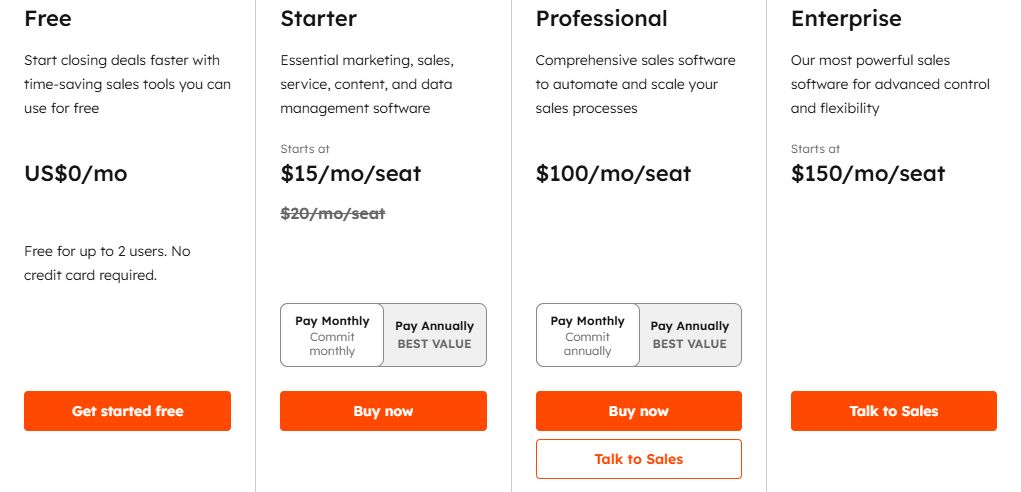
| # | Plan | Price | Best For |
|---|---|---|---|
1 | Free | $0 (up to 2 users) | Basic contact management, 1 deal pipeline, email tracking |
2 | Sales Hub Starter | $20/seat/month | Small teams needing 2 pipelines, calling, meeting scheduling |
3 | Sales Hub Professional | $90/seat/month | Mid-size teams needing automation, sequences, forecasting, custom reporting |
4 | Sales Hub Enterprise | $150/seat/month | Large teams needing custom objects, predictive lead scoring, advanced permissions |
Professional requires $1,500 one-time onboarding. Enterprise requires $3,500.
Marketing Hub is separate and contact-based: Starter $20/month (1,000 contacts), Professional $890/month (2,000 contacts), Enterprise $3,600/month (10,000 contacts).
Breeze Intelligence runs on metered HubSpot Credits. Free enrichment was removed in March 2025.
Lightfield: The best Folk and HubSpot alternative
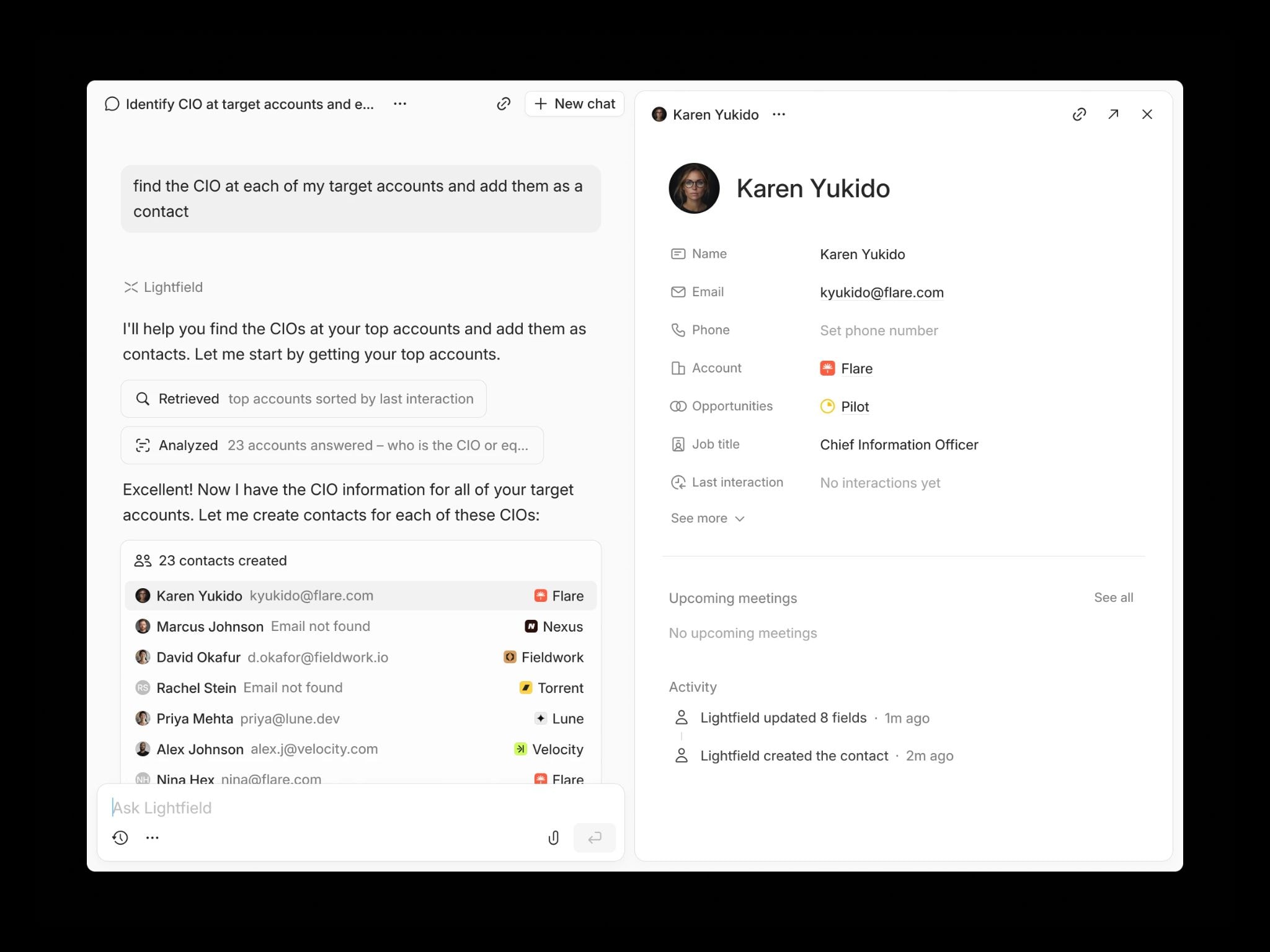
Lightfield captures emails, calls, and meetings automatically, matches them to the right contacts, and turns that into structured CRM records with no manual input. Neither Folk nor HubSpot can do this: Folk requires manual logging outside of LinkedIn. HubSpot captures email and calendar activity but not call context, verbal commitments, or conversational nuance.
Key features
- Every inbound and outbound email mapped to contacts automatically
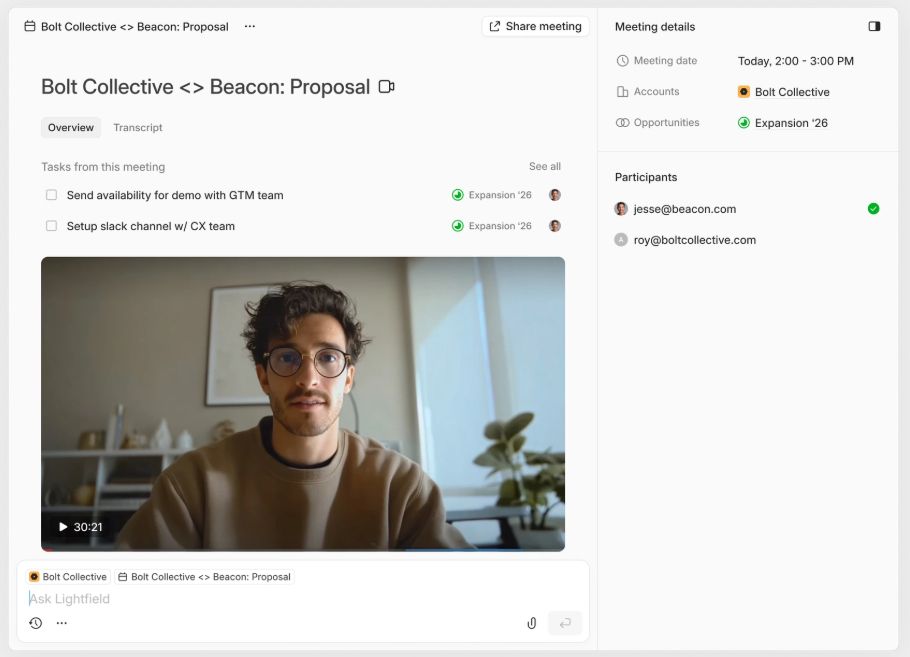
- Built-in call recording with searchable transcripts tagged to accounts
- AI surfaces relationship gaps and dormant contacts before they go cold
- Natural language queries across your full conversation history with cited answers
- Retroactive custom fields: add a field today, Lightfield backfills it from past conversations
- Up to two years of historical conversation data ingested at signup
Lightfield pricing
Lightfield pricing
Starter
$89/user/month, up to 3 users. 14-day free trial.
Larger teams doing more complex agentic work can move to a team plan with unlimited viewer seats.
Pro
Visit lightfield.app/pricing for details.
Growth
Visit lightfield.app/pricing for details.
Why teams choose Lightfield
1. Conversations become CRM records automatically.
Folk captures contacts fast but not what was said. HubSpot logs emails and calendar events but not call context, promises, or next steps. Lightfield records every email, call, and meeting and turns that into structured data without manual input.
2. Pooled credits, no contact-based pricing.
Folk meters enrichment through workspace-wide credits. HubSpot charges per marketing contact and per Breeze credit. Lightfield's self-updating CRM and Chat are included with your seats. On Pro and Growth, agent work draws on workspace credits pooled across the workspace, with a usage dashboard, alerts, and an optional hard cap.
3. Call intelligence on every plan.
Folk doesn't offer call recording at all. HubSpot gates conversation intelligence behind Sales Hub Professional ($90/seat/month). Lightfield includes call recording, transcription, and AI summaries with every capture seat, starting on the Starter plan.
4, No mandatory onboarding fees.
HubSpot charges a one-time onboarding fee of $1,500 at Professional and $3,500 at Enterprise. Lightfield requires zero upfront configuration. Connect your email and calendar and it starts working.
5. Replaces the tool stack, not just the CRM.
Folk + a transcription tool + a separate notes setup. HubSpot + Fathom + spreadsheets. Lightfield handles recording, transcription, summaries, and follow-up drafting in one product.
The CRM that works for every founder-led sales team
Folk is the right CRM if you want a fast, lightweight tool for LinkedIn-based outreach and contact management. HubSpot is the right CRM if you want an all-in-one platform with marketing automation and are prepared for the cost.
But both tools share the same gap: they depend on your team to log what happens in conversations. Context gets lost, follow-ups get missed, and the CRM slowly drifts from reality.
Lightfield closes that gap. Every conversation is captured, structured, and searchable from day one — with no extensions to install and no manual logging.
CTA: Request a demo