Debunking CRM Myths at SaaStr AI
Justin Gonzalez
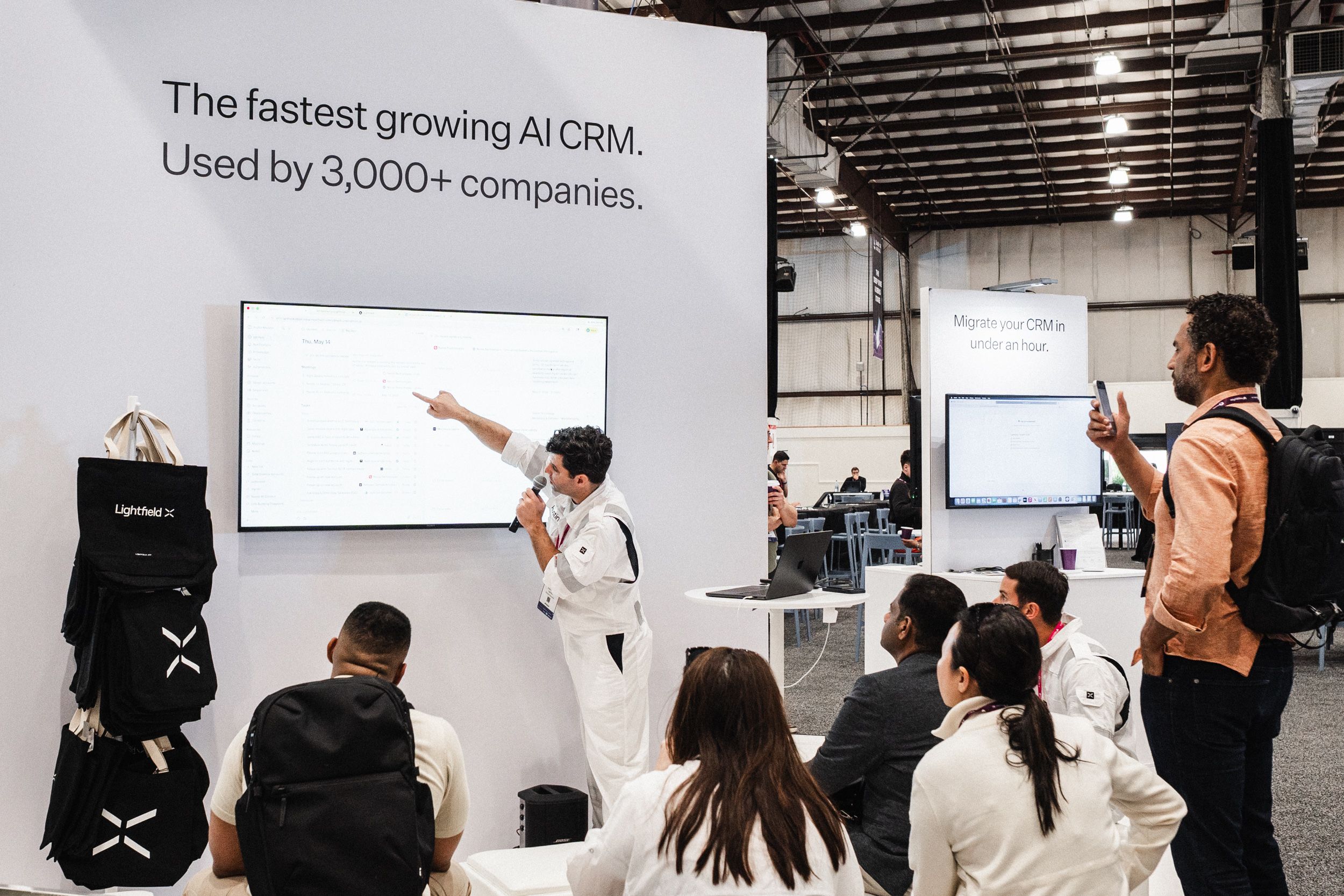
The same assumptions came up over and over on the SaaStr AI Annual expo floor last week. Here’s what we heard, and what we showed.
"Migrating CRMs takes months."
The standard expectation: hire a consultant, map your fields, clean your data, brief your engineering team, wait. We heard this constantly.
Our team migrated dozens of companies off their legacy CRM onsite. Hand an export of your CRM data to the Lightfield agent via chat. It asks a few questions, then rebuilds your CRM. Miriam Koga migrated Harumi off HubSpot in 15 minutes. Mason Cosby migrated Scrappy ABM in under an hour.
The surprise wasn't the speed. It was the realization that painful migration is something the industry normalized, not inherent to switching CRMs.
"Building reports means calling in a data analyst."
In legacy CRM systems, building a custom report means filters, fields, and usually someone technical in the room. We heard this from founders and sales leaders who'd given up on pipeline visibility entirely because it was too much work to get.
In Lightfield, you ask and the agent pulls the answer. What used to be a project is a conversation.
"We're building agents to replace pieces of our GTM stack."
A lot of the conversations at SaaStr centered on agent infrastructure: which tool for enrichment, which for sequencing, which for call notes. Everyone assembling their own stack of point solutions, each with its own agent layer.
All of it should run inside a system that already has the full context of your business. Agents that operate in isolation — without your deal history, your contact relationships, your won-deal patterns — are starting from scratch every time.
"AI pipeline generation just means more generic outreach."
Most AI outbound tools pull from the same external databases, run the same enrichment, send the same emails.
Lightfield starts from the inside. It looks at your entire CRM history to surface the things that made deals close quickly and the signals that predict your best customers. Then proposes an outbound sequence that’s tailored per recipient based on what’s actually in your data. Your agents continuously find new accounts and refine their outreach based on what’s converting.
It’s specific because it’s yours.
"You need a RevOps hire to keep your CRM healthy."
An up-to-date CRM is treated as an operational headcount problem. Hire to maintain it, or live with the mess indefinitely.
Lightfield is built for teams that don't have that. Auto-capture keeps records current. The agent handles the questions that used to require a dashboard. All you do is prompt it.
"AI CRM is just a chatbot on top of stale data."
Legacy CRMs read from the same underlying records: whatever humans remembered to type in. The intelligence is only as good as the data, and the data is only as good as rep compliance.
Lightfield captures the source data automatically. The agent reads the truth: every email, every call, every meeting, structured chronologically so it understands not just what happened but when and why. The architecture is different. That's why the answers are different.
The through-line across every conversation at SaaStr: people have built entire workflows around the limitations of legacy CRM solutions. Automations to compensate for missing data. Analysts to build reports. Consultants to handle perceived complexity.
The product should do that work. That product is Lightfield.
Related Articles
Inc.: Your CRM Was Built for a World Before AI. That’s Why Your Agents Keep Failing
LightfieldOct 2, 2026
Coruzant Technologies: AI-Native CRM: Why Lightfield Redefines the Future of CRM Software
LightfieldMay 27, 2026
San Francisco Examiner: Lightfield: Among the Best AI CRM Tools for Startups
LightfieldApr 14, 2026