The best CRMs for technical founders in 2026
Lightfield
Quick summary
Most CRMs were built for sales teams with dedicated admins, not technical founders running a full GTM motion solo. This guide covers the three best options for early-stage teams in 2026 — evaluated on AI capabilities, setup overhead, pricing transparency, and how well each one actually fits the way founders work.
| Tool | Best for | Why teams pick it |
|---|---|---|
Lightfield | Technical founders who want AI-native workflows | Executes in natural language — queries, follow-ups, and automations without manual setup |
Attio | Founders who want full control over their data model | Composable CRM structure that reflects how you actually think about your pipeline |
HubSpot | Teams with dedicated marketing and a need for an all-in-one platform | Broad feature set covering CRM, email marketing, sequences, and reporting in one place |
Why CRM choice matters more at the early stage
The CRM decision compounds. A system that creates friction — manual logging, complex configuration, opaque pricing — costs a technical founder hours every week at exactly the stage when every hour is leverage. The right CRM disappears into your workflow. The wrong one becomes a second job.
Most of the market is still built around the assumption that a sales team runs the CRM. For technical founders doing founder-led sales, that means inheriting a system designed for someone else. The options have gotten meaningfully better in the last two years, with a new class of AI-native tools that rethink what a CRM should actually do. This list covers the three that are worth evaluating seriously in 2026.
The top 3 CRMs for technical founders
| Tool | Best for | Ai capabilities | Setup time |
|---|---|---|---|
Lightfield | Technical founders, founder-led sales | Agentic — executes workflows in natural language | Fast — CSV migration, live same day |
Attio | Technical teams wanting composable data model | Assistive — enrichment, research agent | Fast — intuitive for technical users |
HubSpot | Mid-market teams with marketing and sales orgs | Assistive — AI writing, predictive scoring | Slow — weeks of configuration |
1. Lightfield — best for: technical founders doing founder-led sales
What it is
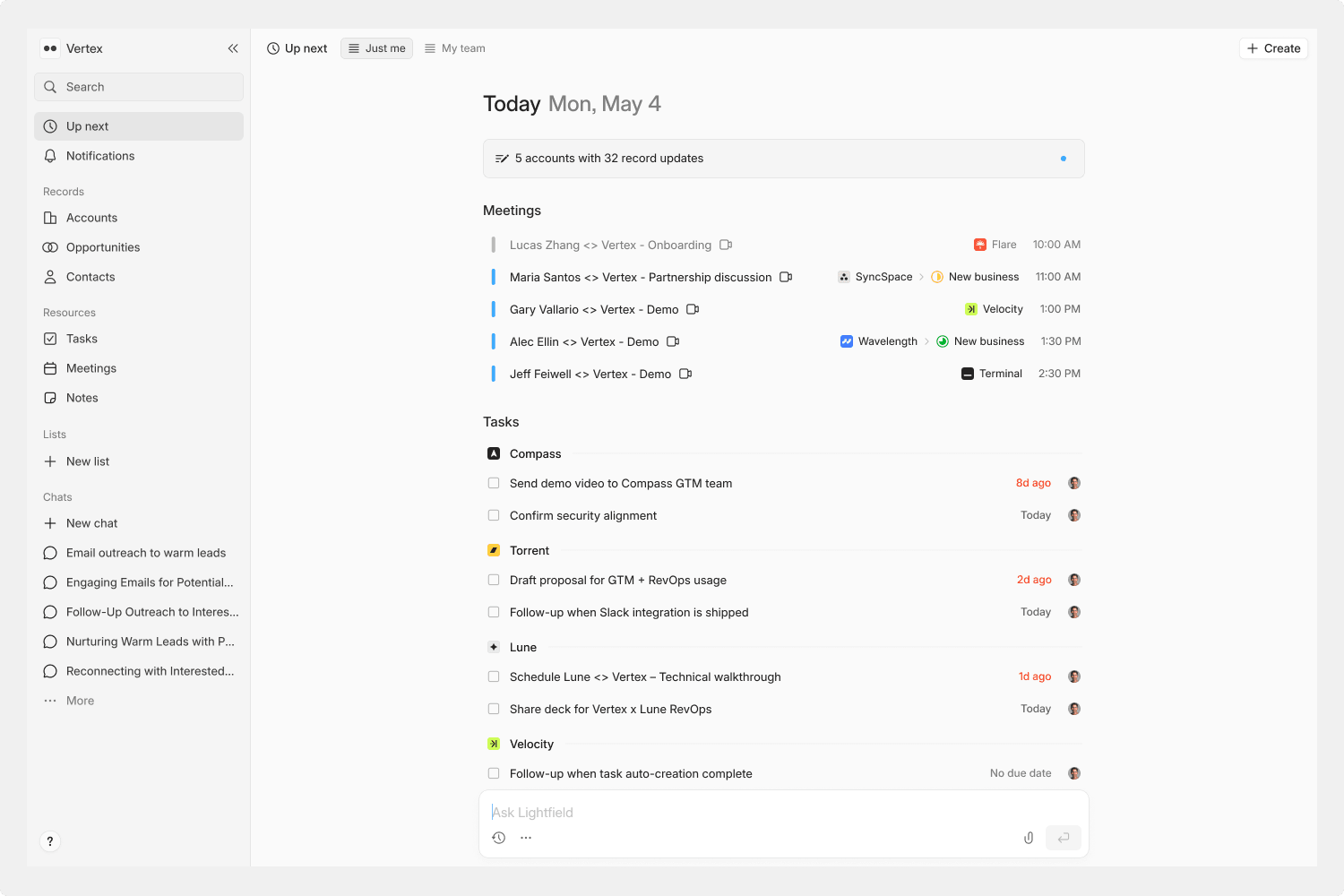
Lightfield is an AI-native CRM built specifically for technical founders and early-stage teams. Where most CRMs store data and wait for you to act on it, Lightfield is designed to act on your behalf — querying your pipeline in plain English, drafting follow-ups autonomously, and executing automations you describe in natural language rather than configure through a UI. It's the operating assumption behind Lightfield: that the CRM should do the work, not just hold the data.
Key features
- Natural language pipeline queries and updates
- Agentic automations — AI takes actions, not just suggestions
- Workflow builder: describe what you want, Lightfield builds it
- Contact and company intelligence built in
- CSV-based migration — switch in minutes, no manual cleanup
- Clean, minimal interface designed for founders, not sales teams
Tradeoffs
- Higher per-seat price than Attio at entry level
- Newer product — less third-party ecosystem than HubSpot or Attio
Best for
Technical founders running a sophisticated sales motion without a dedicated sales team. Especially strong for teams that want AI to handle the manual work — logging, follow-up, context retrieval — rather than just assist with it.
Bottom line
Lightfield is the only CRM on this list built from the ground up around the assumption that AI is the primary interface. If you want a system that executes rather than suggests, it's the strongest option for technical founders in 2026.
Pricing
Starter
$89/user/month, up to 3 users. 14-day free trial.
Larger teams doing more complex agentic work can move to a team plan with unlimited viewer seats.
Pro
Visit lightfield.app/pricing for details.
Growth
Visit lightfield.app/pricing for details.
2. Attio — best for: technical teams who want to own their data model
What it is
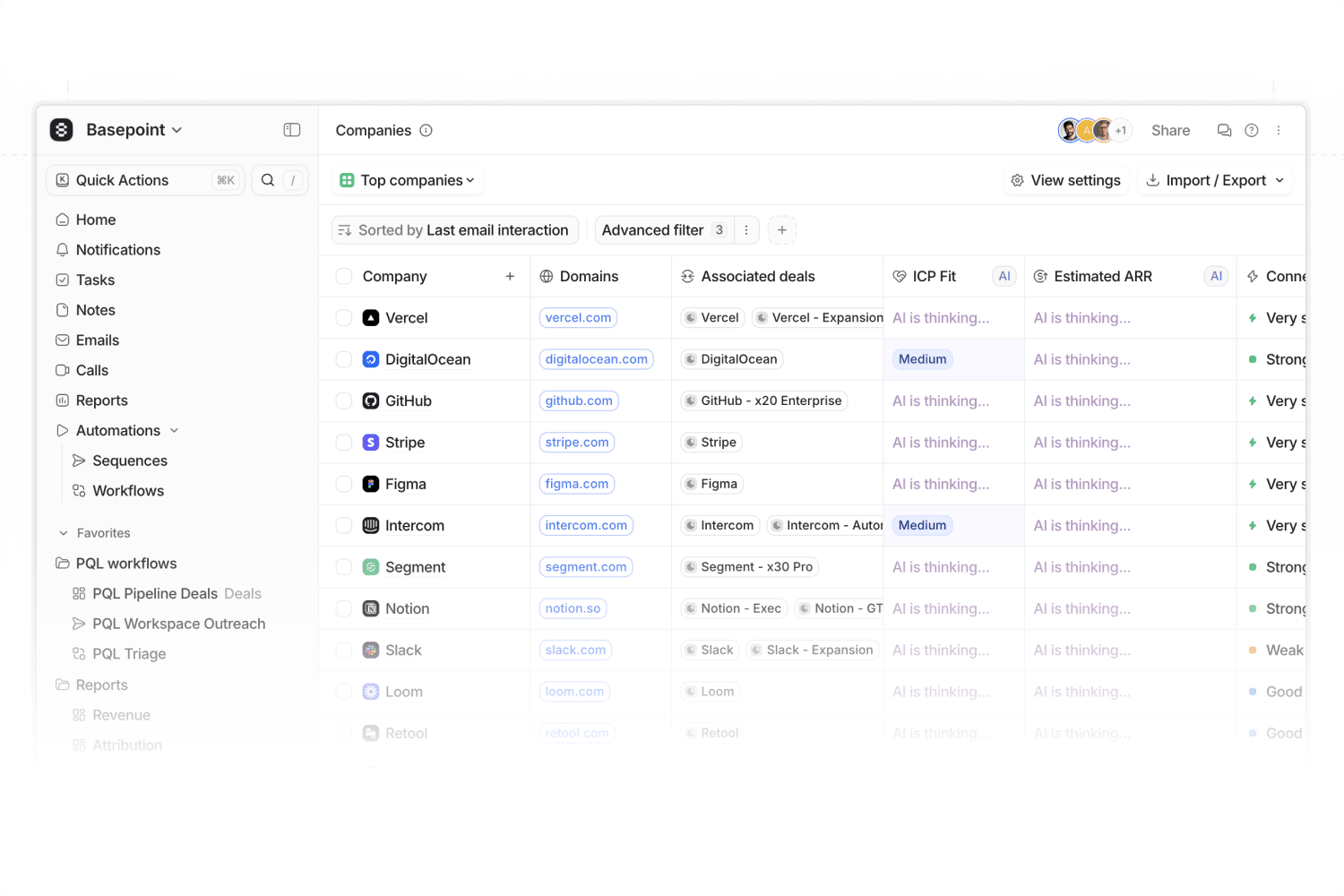
Attio is a modern CRM built around a composable, relational data model. Rather than inheriting a fixed structure of contacts, companies, and deals, you define your own objects, attributes, and relationships — making it genuinely flexible for teams with non-standard pipelines. Founded in 2019 and popular with early-stage startups and VC firms, Attio has built a strong following among technical users who want a CRM that reflects how they actually think about their relationships, not how Salesforce thinks they should.
Key features
- Fully composable object and attribute data model
- Automatic email and calendar sync
- Pipeline views (kanban, list, table)
- Sequences and call intelligence (Pro tier)
- Data enrichment and AI research agent
- Solid integrations: Gmail, Slack, Zapier, API access
Tradeoffs
- AI features are assistive, not agentic — the work still falls to the team
- Sequences, call intelligence, and advanced permissions are Pro-only ($69/user/month annual)
- Credit-based usage layer adds cost unpredictability for teams using AI features heavily
Best for
Technical founders who want maximum control over how their CRM is structured, and who are comfortable assembling additional tools for outbound and enrichment. Strong fit for VC firms, network-driven businesses, and teams with non-standard pipelines.
Bottom line
Attio is the best composable CRM for technical users. The data model is genuinely excellent, the UI is clean, and the free tier is honest. The limitation is that it's a passive system — it stores what you give it, and its AI features assist rather than act. Teams that need automation and outreach will need to build or buy around it.
Attio pricing
| Plan | Annual price | Monthly price |
|---|---|---|
Free | $0 | $0 |
Plus | $29/user/month | $36/user/month |
Pro | $69/user/month | $86/user/month |
Enterprise | Custom | Custom |
All paid plans are billed annually only. No month-to-month option on paid tiers.
3. HubSpot — best for: teams with dedicated marketing and an established sales motion
What it is
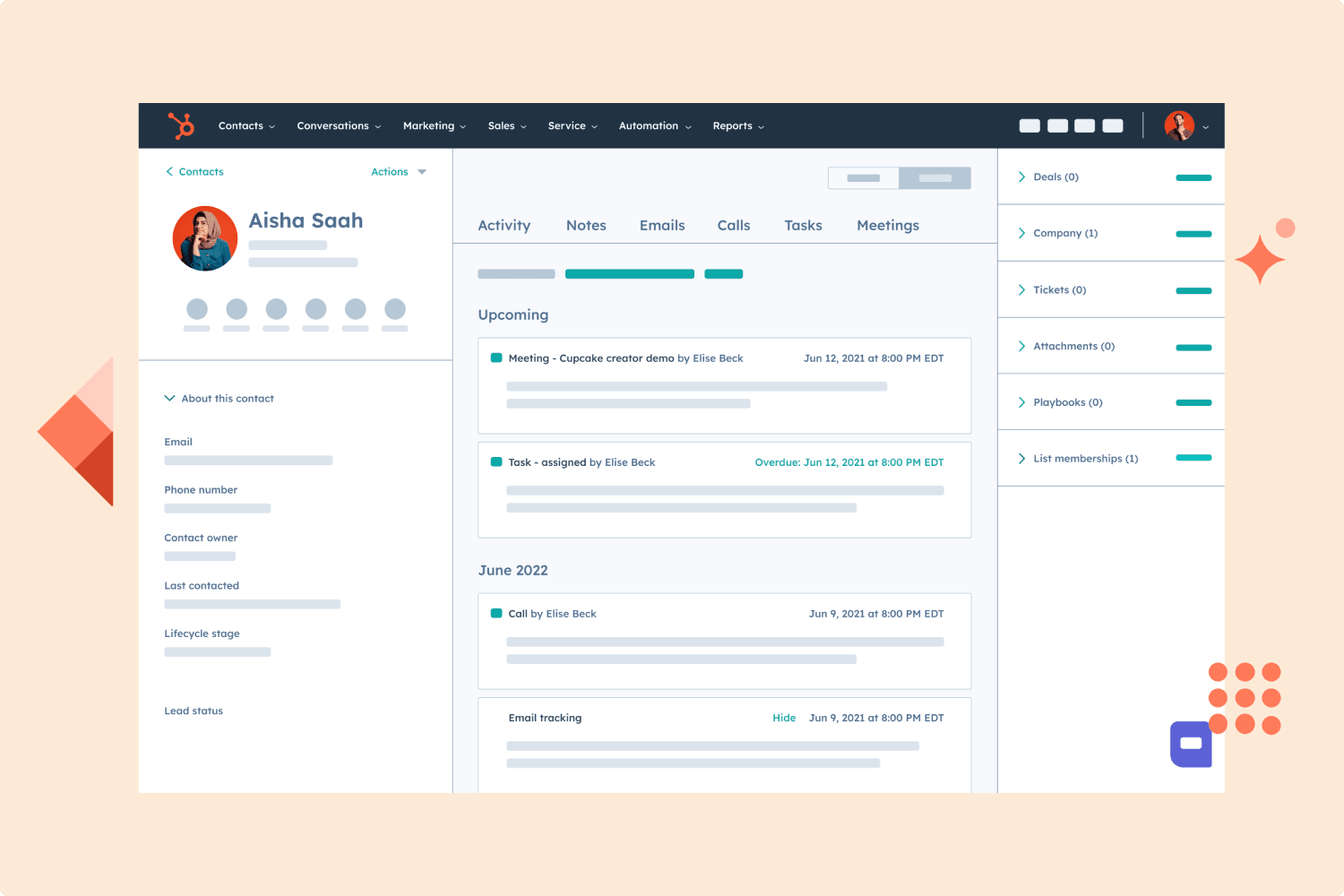
HubSpot is the most widely used CRM platform in the world, covering sales, marketing, and customer service under one roof. Originally built around inbound marketing, it has evolved into a full-stack go-to-market platform with email sequences, ad attribution, lead scoring, live chat, and a massive AppExchange-style marketplace. For companies with a dedicated marketing function and a mature sales motion, the breadth of HubSpot's tooling is genuinely hard to match. For early-stage teams, the overhead is often the problem.
Key features
- Contact, company, deal, and lead management
- Email sequences and templates
- Marketing automation and ad attribution
- AI writing assistant and predictive lead scoring
- Deep reporting and custom dashboards
- 1,000+ integrations via App Marketplace
Tradeoffs
- Expensive at scale — most meaningful features live at Professional ($90/user/month) or above
- Slow to configure — proper setup takes weeks and often requires outside help
- Built for sales teams, not founders — UX assumes role separation and process maturity
Best for
Mid-market teams with dedicated sales and marketing functions, an established process, and the headcount to configure and maintain the platform. Not a strong fit for early-stage founders running lean.
Bottom line
HubSpot is powerful if you have the team and budget to use it. For technical founders doing founder-led sales, the configuration overhead, pricing escalation, and UX assumptions make it a system designed for a different kind of company.
HubSpot pricing
| Plan | Price | What's included |
|---|---|---|
Free | $0 | Basic contact management, limited features |
Starter | $20/user/month | Core CRM, simple sequences |
Professional | $90/user/month | Full automation, reporting, marketing tools |
Enterprise | $150/user/month | Advanced controls, custom objects, intelligence |
HubSpot's pricing compounds quickly when bundling Sales Hub, Marketing Hub, and Operations Hub. A 10-person team with real needs can reach $2,000+/month.
The CRM that works with you, not around you
Most CRMs were designed for a world where reps log calls, admins maintain workflows, and AI is a feature you click on occasionally. That's not how technical founders work. You're moving fast, wearing multiple hats, and you need a system that keeps up — not one that creates a second job.
Lightfield is built around a different assumption. Query your pipeline in plain English. Describe a workflow and let the system build it. Let AI handle the follow-up, the logging, and the context retrieval — so you can focus on the conversations that actually move deals forward.
If you're evaluating CRMs in 2026 and you want one that executes rather than assists, Lightfield is worth a look. Migration takes minutes, there's no configuration backlog to work through, and the AI is the interface — not a button you toggle on.
Ready to make the switch?
Lightfield is free to start and takes minutes to set up. No admin required, no implementation timeline.