An Honest Day AI Review (+ Why Lightfield Is a Better Choice)
Matt Serna
Quick Summary
Day AI and Lightfield both eliminate manual CRM data entry, but the similarity ends there. Day AI builds a context graph that AI agents navigate to retrieve and summarize information. Lightfield builds a world model of your business that agents reason through, with code execution that turns deep customer memory into strategic artifacts, large-scale analysis, and cross-system orchestration. For high-growth companies who want an agent that does real work — not just answers questions — Lightfield is a different category of tool.
Considering Day AI as Your CRM?
Day AI is one of the more interesting entrants in the AI-native CRM wave. Launched in February 2026, it was built by Christopher O'Donnell (HubSpot's former CPO) and Michael Pici (former VP of Product) — two people who helped create the CRM they're now arguing is obsolete. Backed by $24M from Sequoia Capital, Day AI represents a real rethinking of how CRM data gets captured and used.
This review covers what Day AI does well, where it falls short, and why Lightfield is a stronger fit for early-stage teams doing founder-led sales — not just on pricing and setup, but on the quality of work the agent can actually perform.
What is Day AI?
Day AI combines a meeting assistant, CRM, and knowledge base into a single product. Founded in 2023, it spent 18 months in private beta before launching publicly.
They call their approach "CRMx" — "the x stands for context." The product is built around a context graph designed for AI agents to navigate: "Instead of wrestling with your CRM, you just talk to it."
Day AI targets startups as a full CRM replacement and scaling B2B companies as a complement to an existing CRM. It's best suited for revenue and product teams with call-heavy workflows.
Key Features of Day AI
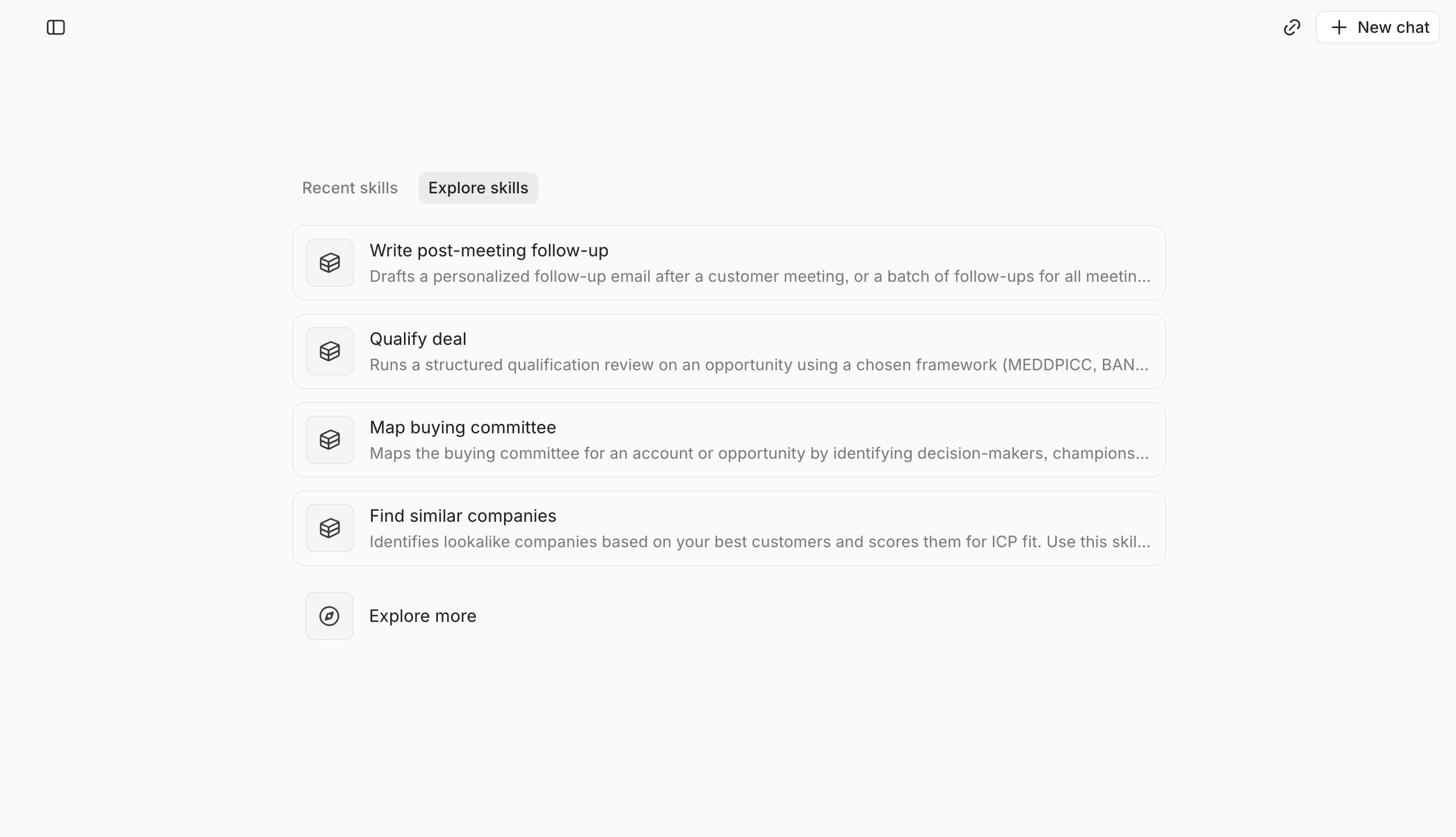
- AI Assistant. The core interface is a conversational assistant you name and interact with directly. "You speak normally. It configures your CRM, builds automations, does research, and asks clarifying questions the way your most capable teammate would." Every action is transparent — the assistant shows its reasoning, sources, and evidence.
- Automatic Data Capture (CRMx). Day AI passively ingests data from calls, emails, Slack, billing, and product usage. "Not just a database. A reasoning system that passively ingests your history across calls, emails, Slack, billing, and product usage. Only structure information when you need it."
- Pipeline Management. Describe your sales process in natural language and Day AI keeps it updated automatically. No rigid setup required.
- Task Management & Follow-ups. The system builds your to-do list and reminds you to re-engage at the right time, with the context you need to pick up the thread.
- Insights & Reporting. "CRMs captured activity. Dashboards displayed it. But neither explained what any of it meant." Day AI goes beyond charts to narrate what's happening and why.
- Integrations. Google Workspace, Zoom/Meet/Teams, Slack, MCP Clients (Claude), and API access.
Day AI Pricing
Day AI has published pricing using a "per agent" model:
| Plan | Price | What's Included |
|---|---|---|
Free | $0/mo | Gmail/Calendar sync, meeting clips, search/share. |
Turbo | $24/mo (billed annually) | Task management, email drafts, web search, 2 automated skill slots. |
Professional | $60/mo (billed annually) | Pipeline management, custom views, custom properties, 5 automated skill slots. |
Executive | $200/mo (billed annually) | Prospecting, advanced custom instructions, 10 automated skill slots. |
Note: 20% discount for annual billing. No usage-based credits or hidden limits. Cancel anytime.
What We Like About Day AI
- Zero manual data entry. Connect Gmail and your calendar, and Day AI builds relationship records from your communication history automatically. Meetings are transcribed and turned into structured CRM updates without you lifting a finger.
- Natural language configuration. Describe complex sales frameworks — MEDDIC, BANT, custom criteria — in plain English and the assistant configures your CRM accordingly. Users report setup in ten minutes.
- Cross-functional utility. Works beyond sales. Product teams track feature requests across conversations. Marketing mines call transcripts for messaging insights.
- Source transparency. Every AI claim links back to the specific meeting or email thread it drew from. You can verify any answer.
- Generous free user inclusion. Workspaces with at least one Professional agent or higher can add colleagues at no cost, which suits teams where only a few people need a full agent.
What We Don't Like About Day AI
- Retrieve-and-summarize ceiling. Day AI's context graph is designed for agents to navigate — to find matching records, blend results, and return a synthesis. That's a meaningful upgrade from traditional CRMs, but it's still fundamentally retrieval. Ask "why did this deal stall?" and you'll get a summary of recent touchpoints. You won't get the relationship dynamics — the moment your champion's language shifted, the response times that doubled after an internal reorg, or the objection pattern that predicted the loss three calls before it happened. That requires a different kind of data architecture.
- Assistant-centric model adds friction. Day AI's value depends on learning to prompt the assistant effectively. The "Cursor for CRM" analogy is telling — powerful, but it requires a skilled operator. Founders who want an agent that works in the background may find this interaction model adds overhead rather than removing it.
- More complex pricing structure. Four tiers with varying skill-slot limits and agent capabilities requires real evaluation to find the right fit. Lightfield's published plans are priced per user or per workspace, with no per-agent tiers to compare.
- Higher price ceiling. Day AI's Executive tier is $200/month per agent, billed annually. Lightfield Starter is $89/user/month for up to 3 users, and Pro is $999/workspace/month with 5 capture seats and unlimited viewer seats.
- Opaque "Schedules" concept. Tiers are partly differentiated by the number of automated skill slots included (2, 5, or 10). Not immediately intuitive without reading documentation.
A Better Day AI Alternative: Lightfield
The difference between Day AI and Lightfield isn't a feature list. It's architectural — and it determines what kind of work the agent can actually do.
Most CRM agents — including Day AI's — work the same way at their core. They store data, and when you ask a question, they search for matching records, blend results, and return a synthesis that sounds smart on the surface. Every CRM will have this capability soon. It's table stakes.
Lightfield is built on a different foundation. Where Day AI organizes data into a context graph for agents to navigate, Lightfield organizes customer data as a semi-structured business graph — a world model of networked people, relationships, and businesses. Every customer interaction is stored as raw, unstructured context. You don't define fields upfront or decide what to track before you know what matters. You start with complete context and apply structure as your understanding evolves.
This architecture enables Lightfield to build a continuous narrative for each account — chronologically ordered, relationship-aware. It tracks how conversations developed across emails and calls, how sentiment shifted, who deferred to whom, what promises were made and whether they were kept. When the agent looks at an account, it doesn't see disconnected records. It sees a story with characters, dynamics, and a trajectory.
That's what enables the agent to answer "why" questions, not just "what" questions. And it's the foundation that makes code execution — Lightfield's most significant recent capability — qualitatively different from bolting execution onto a retrieve-and-summarize system.
Key Features of Lightfield
- Auto-Capture CRM. Reads emails, meeting transcripts, and conversation records to compile customer relationship history automatically. Accounts, contacts, and opportunities are created from your actual interactions.
- Integrated Call Recorder. Built-in meeting prep, video recording, transcription, and auto-generated follow-ups. No separate Fathom or Fireflies subscription needed.
- Schema-less Memory Architecture. No upfront field configuration. Captures everything in raw form from day one. Create a custom field like "current CRM" at any point, and the system backfills from all past conversations automatically. Evolve your data model over time without losing history.
- Code Execution on Full Customer Memory. This is the capability that separates Lightfield from every other AI CRM — including Day AI. The agent writes and runs Python with access to your complete customer memory. It plans an approach, writes code to execute it, runs it, evaluates results, and iterates.
- Agentic Chat Over All Customer Data. Query your CRM in natural language. Ask "which customers asked about Slack integration?" and get answers with citations. Ask "build a competitive battle card against [competitor]" and the agent reads every conversation where they were mentioned, interprets how prospects compare you, and produces a structured document grounded in what customers actually said.
- Deep Meeting Intelligence. Full context before every meeting — what happened last time, what the customer cares about, what to bring up. Prep notes delivered automatically.
- Personalized Multi-Account Email Drafting. Draft follow-ups that reference exact customer language. Find stale prospects via natural language query, then draft personalized revival emails in bulk — each grounded in the specific relationship history.
- Custom Fields with AI Auto-Population. Create any field. AI captures relevant information from transcripts and emails — forward and retroactively. Enrich with web search and waterfall enrichment across your entire CRM.
- Workflow Builder. Automated workflows for record creation, field updates, webhook triggers, and HTTP out blocks. No Zapier dependency.
Lightfield Pricing
| Plan | Price | What's Included |
|---|---|---|
Free | $0/mo | Gmail/Calendar sync, meeting clips, search/share. |
Turbo | $24/mo (billed annually) | Task management, email drafts, web search, 2 automated skill slots. |
Professional | $60/mo (billed annually) | Pipeline management, custom views, custom properties, 5 automated skill slots. |
Executive | $200/mo (billed annually) | Prospecting, advanced custom instructions, 10 automated skill slots. |
Both tiers include:
- Call intelligence (record, transcribe, analyze)
- Automated data enrichment and record updates
- Unlimited agent queries and actions
- Email and calendar sync
- Configurable data model
- Agent workflow builder
Pro adds: Advanced permissioning, white glove migration/onboarding, dedicated CSM.
Why Founders Choose Lightfield Over Day AI
The agent produces higher quality output. We asked our own Lightfield agent to extract feedback from our customers who switched from Day AI to Lightfield. Many switched due to feedback about agent quality:
- “I'm paying like 75 bucks a month for that and I'm quite dissatisfied with that product actually… it just basically doesn't work yet."
- "It probably errs on the side of being probably a bit too aggressive in moving deals."
- "The AI app crashes… because you're unconstrained in the input… if I ask something where there hasn't been a tool call made that would allow it to do that, the thing crashes."
The agent does fundamentally different work. This is the core distinction. Day AI's agent retrieves and summarizes from a context graph. Lightfield's agent reasons through a complete model of your business, writes and executes code against your full customer memory, and produces work at the level of your best sales leaders.
Lightfield gives you artifacts, not just answers. Code execution means the agent produces board-ready pipeline reports, competitive battle cards built from real customer language, rep scorecards grounded in actual call analysis, and account expansion plans mapped to specific stakeholder dynamics. Day AI gives you text summaries. Lightfield gives you deliverables.
Lightfield offers simpler pricing. Both publish pricing. Lightfield has four plans (Starter, Pro, Growth, Enterprise), with Starter at $89/user/month and Pro and Growth priced per workspace. No skill-slot limits, no agent tiers to decode.
Conclusion
Day AI is a credible product with strong founders and real technical ambition. For teams who are just looking for a conversational AI assistant to manage their CRM, it's worth evaluating.
But the question isn't just whether an AI CRM eliminates data entry — they all will. The question is what your agent can do with the data once it has it. Day AI's agent retrieves and summarizes. Lightfield's agent reasons through a complete model of your business, writes and executes code against your full customer memory, and produces work at the level of the best sales leaders and AEs.